

Corporate golf is one of the most effective ways to make the low season profitable. Midweek, outside the high season, many golf courses have capacity that simply goes unused. At the same time, hundreds of companies look every year for a place to hold a team-building day, a sales convention or a client hospitality event. That these two facts do not meet more often is, above all, a problem of commercial positioning, not of demand.
Why corporate golf fits the low season so well
A company organising a corporate golf day does not need the best tee time on a spring Saturday: on the contrary, it values the exclusivity of having the course practically to itself, which is much easier to offer midweek or in months when fewer members play. For the club, this means monetising precisely the slots that generate the least revenue today.
What a company really looks for when choosing a club
Beyond the course itself, a company organising a corporate event values the complete logistics: an all-inclusive package with a beginners’ clinic for those who do not play, a tournament in a format accessible to all levels, a lunch or cocktail afterwards and a single point of contact at the club who takes care of the whole organisation. The fewer arrangements the company has to make itself, the more likely it is to come back every year.
How to start winning this segment
The most effective route is not to wait for companies to call, but to go out and find them: contact the HR and marketing departments of companies in the club’s catchment area, offer an all-inclusive package with a clear price from the first contact, and use every corporate event as an opportunity for attendees who are not members to discover the club at its very best.
The side effect many clubs do not factor in
A well-run corporate event does not end with the event’s invoice: it is also one of the ways of attracting new members with the best conversion rate, because attendees have already experienced the club first-hand, something no advertising campaign can match. That is why each corporate day should be treated as a sales action in itself, with follow-up afterwards for interested attendees. Done well, that follow-up turns a one-off day into a lasting commercial relationship.
The Royal Spanish Golf Federation actively promotes golf in the business world as a way to grow the sport, and for a club, corporate golf is the most direct way to turn that interest into concrete revenue during the low season. At NGM Golf & Sports Consulting we design this commercial strategy within our marketing and sales service, building the product package and the B2B acquisition channel needed for local companies to discover the offer before organising their day anywhere else, and to repeat the experience year after year.
How to design corporate golf packages that sell themselves
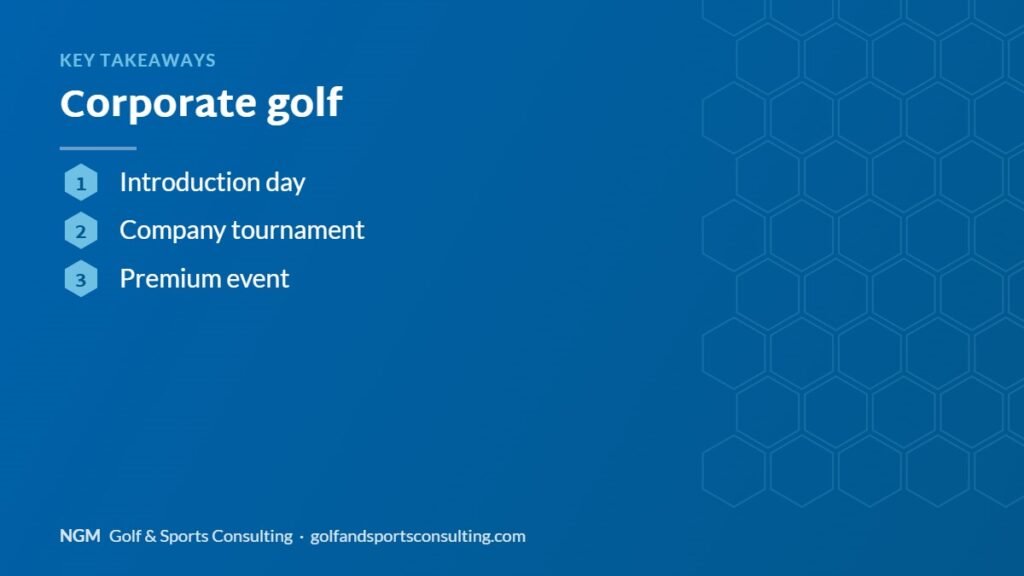
Companies do not buy hours on the course, they buy a day that works. That is why it pays to offer all-inclusive corporate golf packages that are easy to understand, with a price per person and optional extras. A structure that works well has three levels:
- Introduction day: golf clinic with a professional, chipping and putting competition, and lunch at the club. Ideal for teams that have never played.
- Company tournament: shotgun start, scramble format, welcome gifts, prize-giving and a closing cocktail.
- Premium event: meeting room in the morning, golf in the afternoon and dinner with a personalised menu.
Each package should explain what it includes, how long it lasts and what the company needs to provide. The less the organiser has to think about, the easier it is for them to confirm.
Channels to attract corporate golf clients
The first channel is the club’s own membership. Many members run companies or work in HR and marketing departments, so direct communication usually generates the first bookings.
The second channel is the club’s website. A dedicated company events page, with real photos, testimonials and a simple form, captures searches from organisers looking for alternatives to conference hotels.
The third is local partnerships: nearby hotels, event agencies, business associations and chambers of commerce. Offering them a commission or a special rate turns these partners into an additional sales force.

What to measure after each event
After each day, record total revenue, average spend per attendee and the organiser’s satisfaction. It is also useful to note how many participants later come back as green fee players or ask about membership. That figure shows that the event not only fills the low-season calendar but also feeds the club’s future member acquisition.
Corporate golf all year round
Although the low season is the ideal time to start, corporate golf can become a stable revenue line throughout the year. Companies hold conventions in spring, client dinners before the summer and end-of-year celebrations in December. A sales calendar that anticipates these dates makes it possible to contact organisers in good time and close bookings before the competition.
Corporate golf also fits employee wellbeing programmes: weekly lessons, internal leagues between departments or discounted company passes. These formats create a recurring relationship with the company and turn a one-off event into a loyal club customer. If you want to launch a corporate golf offer at your club, NGM can help you design and market it.