
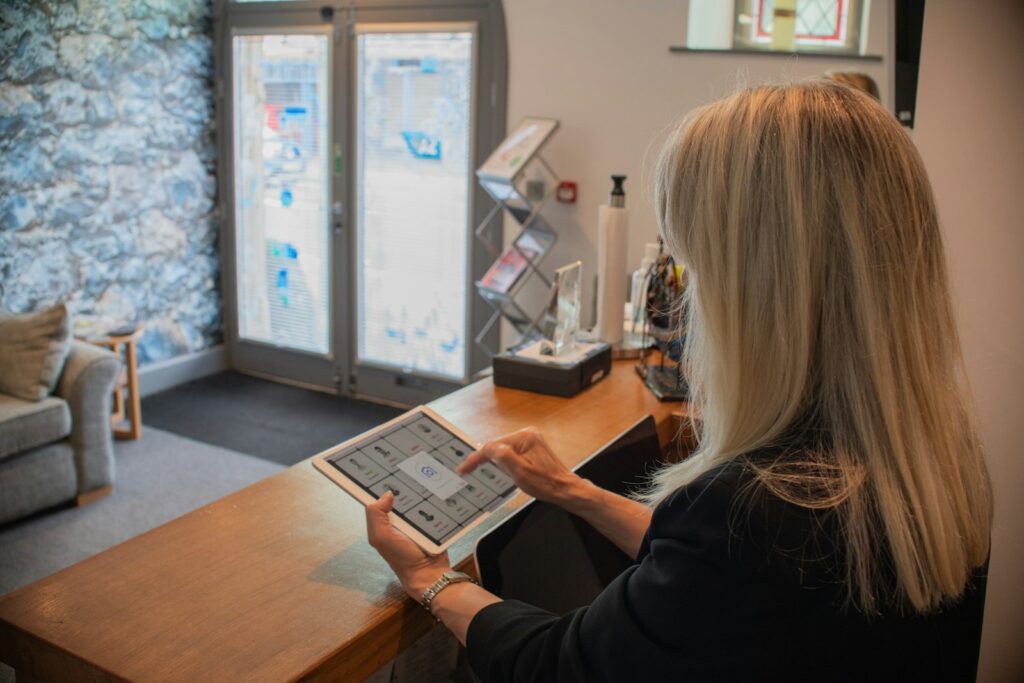
At a golf club, the personal relationship with each member is part of the value proposition: it is what distinguishes a club from a simple sports service provider. That is why many club managers distrust the word “automation”, as if it meant losing that personal touch. Properly implemented, a CRM does exactly the opposite: it frees up time so that the personal touch goes to whoever really needs it at each moment.
What a CRM means in practice for a golf club
A CRM brings together in a single profile everything the club knows about each member or customer: when they joined, which services they use, when their membership expires, whether they have shown interest in lessons or an event, or whether they have not set foot on the course for months. Instead of that information being scattered between reception’s memory, the marketing spreadsheet and the invoicing system, the whole team works from the same up-to-date picture of the member.
Automating acquisition without sounding like a robot
Member acquisition improves a great deal when the first contact (a web enquiry, a trial visit, a call about a tournament) goes straight into the CRM and triggers an automatic follow-up: a welcome email, a call scheduled three days later, a reminder before the welcome offer expires. The message can, and should, be written in the same friendly tone as always; what changes is that it no longer depends on someone remembering to do it on time.
Building loyalty before members think about leaving
Membership renewal is the moment when having a CRM, or not, makes the biggest difference. Instead of waiting for the expiry date, the system identifies weeks in advance the members whose activity at the club has dropped (fewer bookings, fewer visits to the restaurant, no lessons in the last year) and triggers a personal contact before leaving has already become a decision.
What a good CRM for a golf club should include
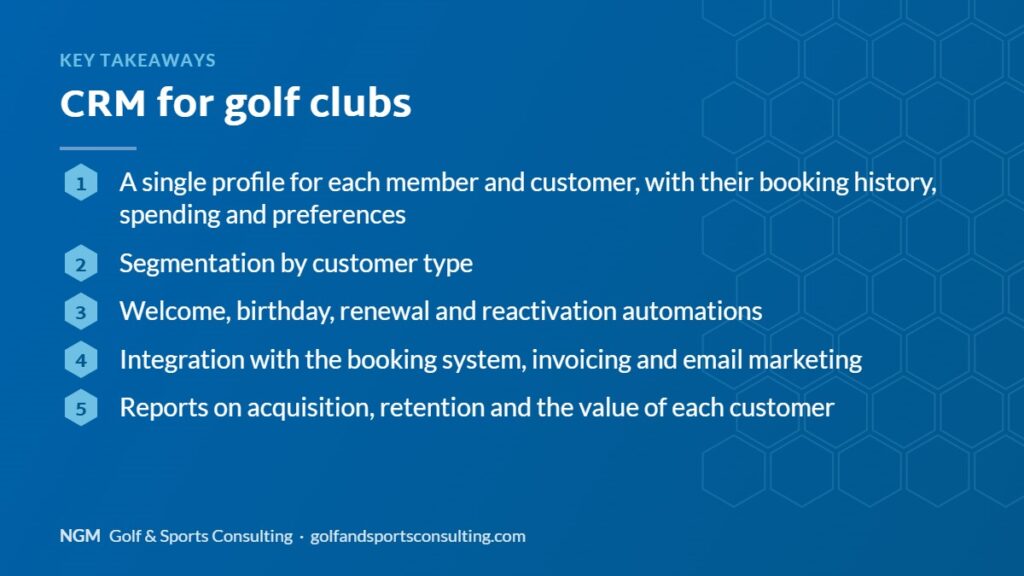
- A single profile for each member and customer, with their booking history, spending and preferences.
- Segmentation by customer type: members, season-pass holders, green fee players, families, companies.
- Welcome, birthday, renewal and reactivation automations.
- Integration with the booking system, invoicing and email marketing.
- Reports on acquisition, retention and the value of each customer.
How to implement a CRM step by step
The first step is to put the data in order: merge the member and customer databases, remove duplicates and obtain the necessary consents. Next, define the segments and key messages for each one, and switch on the first automations, starting with the simplest. Finally, measure every month which campaigns work and adjust the plan. A CRM is not a project that ends, but a way of working.
Indicators to measure the CRM
To know whether the CRM is delivering results, track the member renewal rate, the conversion of green fee players into season-pass holders or members, how often each customer plays, average spend on catering and in the shop, and the response to email campaigns. With this data, management can decide where to focus its commercial effort.
Frequently asked questions about CRM
Does a small club need a CRM? Yes, even more so: with small teams, automating the follow-up of members and customers frees up time and avoids missed opportunities.
Can the CRM integrate with the club’s management software? That is the recommended approach, so that booking and spending data update automatically and the CRM always works with real information.

Common mistakes when choosing a CRM
The first mistake is buying the tool before defining the process. A CRM does not organise the relationship with members on its own: it reflects the way the club works. If nobody has agreed beforehand who records each contact, what stages a season-pass sale has or how a complaint is handled, the system fills up with incomplete data and the team stops trusting it.
The second mistake is not integrating the CRM with the booking software and invoicing. When each tool lives in isolation, staff duplicate tasks and the member profile is never complete. Integration is what turns data into useful decisions.
The third is forgetting ongoing training. Every quarter it is worth reviewing real usage, cleaning up duplicates and sharing with the team the results the CRM has made possible, because seeing the value in figures is what turns it into a habit.
The balance between data and warmth
The key to a well-used CRM at a golf club is not sending more communications, but sending the right ones to the right person at the right time, and letting the human team concentrate on the conversations that really need closeness: a complaint, a special request, welcoming a new member in person.
The sector itself confirms it: the Royal Spanish Golf Federation highlights in its training materials that member loyalty is one of the great challenges for any club, and a well-implemented CRM is the tool that makes it possible to tackle it systematically. At NGM Golf & Sports Consulting we design this automation within our marketing and sales service, always starting from each club’s own tone of voice, integrated with daily management through Total Management. If you want to stop losing members through lack of follow-up, let’s talk.