

Data protection is one of a club’s least visible responsibilities, and also one of the most sensitive. A golf club with more than 2,500 members manages, almost without thinking about it, one of the most complete personal databases any business of its size can have: names, addresses, bank details for fee direct debits, booking history, spending habits at the restaurant and even, in some cases, health data related to sport. All that information is subject to the GDPR, and very few clubs really have it under control.
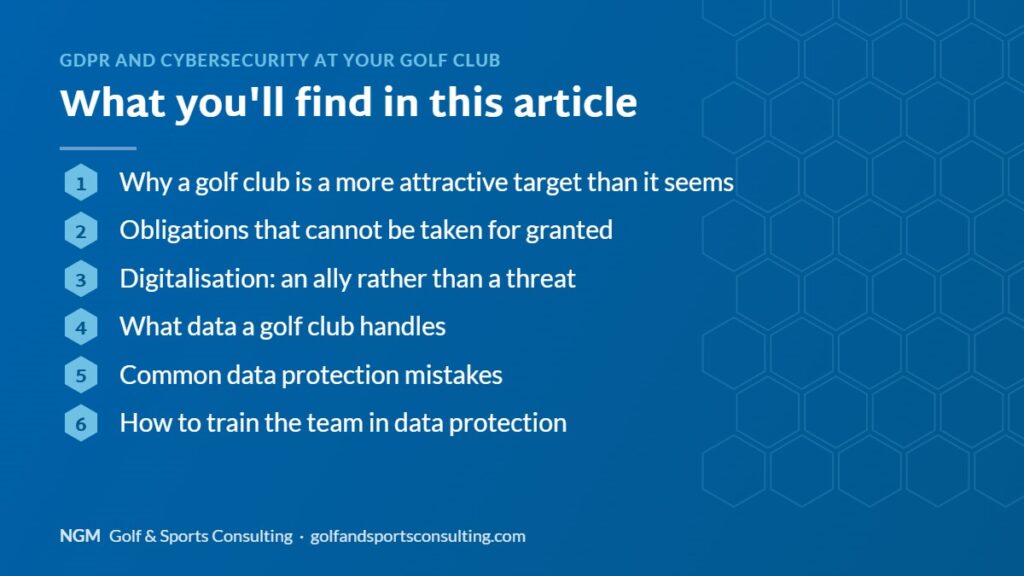
Why a golf club is a more attractive target than it seems
The typical socio-economic profile of a golf member makes a club database especially valuable for a phishing attack or a leak for fraudulent purposes. On top of that, many clubs still manage part of that information in shared spreadsheets, loose emails or old systems without encryption, which multiplies the risk compared with a club that centralises its data in a single management system with access controls.
Obligations that cannot be taken for granted
Among other things, the GDPR requires clubs to clearly inform each member about what data is collected and why, obtain explicit consent for marketing communications, allow any member to request and exercise their rights of access, rectification or erasure, and notify any serious security incident to the data protection authority (in Spain, the AEPD) within 72 hours. Non-compliance is not just a legal risk: fines for serious infringements can reach several million euros.
Digitalisation: an ally rather than a threat
There is a perception that digitalising more processes increases the risk of a leak, but in practice the opposite happens when it is done well: a centralised management system, with automatic backups, control over who accesses each piece of data and activity logs, protects far better than information scattered across loose files that nobody fully controls. Regular reviews also reduce the risk of fines in the event of an inspection or a member’s complaint, and build greater trust among those who share their data with the club.
What data a golf club handles
A golf club processes more personal data than it seems: identification and contact details of members and customers, bank details, booking and spending history, security camera images, data on minors at the academy or summer camps and, increasingly, digital access records. All of it is subject to data protection rules and must be handled with care.
Common data protection mistakes
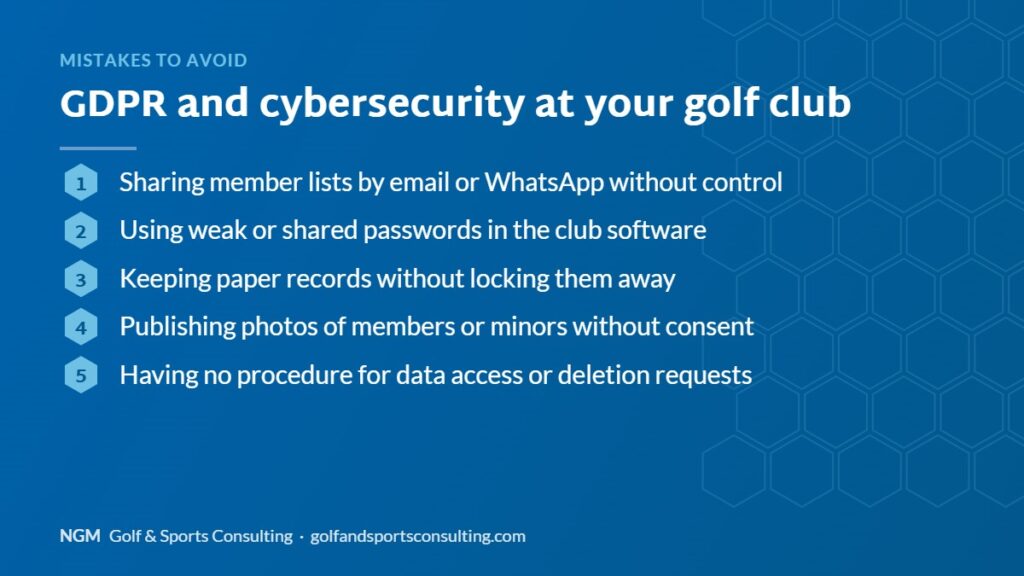
- Sharing member lists by email or WhatsApp without control.
- Using weak or shared passwords in the club’s software.
- Keeping paper records without locking them away.
- Publishing photos of members or minors without consent.
- Having no procedure for handling data access or erasure requests.
How to train the team in data protection
Most incidents are caused by human error. That is why it is important to train reception, administration, academy and catering staff in the basics of data protection: how to spot fraudulent emails, what information can be shared and with whom, how to keep documents safe and what to do in the event of a possible security breach.
Frequently asked questions about data protection
Does a golf club need a data protection officer? It depends on its size and the type of processing; it is best to check with a specialist adviser.
Does digitalisation help data protection? Yes: management software with individual user access, backups and activity logs protects information better than paper and spreadsheets.

How to respond to a security breach
No club is immune to an incident: an email with member data sent to the wrong person, a stolen computer or unauthorised access to the management software. What matters is having a protocol ready before it happens.
The protocol should state who coordinates the response, how the scope of the incident is assessed and within what timeframe it is notified. The rules require breaches that pose a risk to individuals to be reported to the supervisory authority within 72 hours of becoming aware of them, and in serious cases to the people affected as well.
Every incident should be recorded, even when it does not need to be notified, together with the measures taken to prevent it from happening again. That record demonstrates diligence in an inspection and helps improve the club’s internal processes year after year.
Three steps any club can take now
Audit where each piece of member data really lives within the club, review and update the privacy policy and marketing consents, and limit access to sensitive information to the staff who need it for their work. These are low-cost measures that drastically reduce the risk of a fine or a reputational incident.
The Spanish Data Protection Agency reminds businesses in its guides that any organisation that regularly processes personal data, as a golf club does, must be able to demonstrate at any time that it complies with the GDPR, not just declare it. At NGM Golf & Sports Consulting we build that requirement into our management software, with data protection by design, so that every piece of member data lives in a centralised system with access control and backups, rather than spread across spreadsheets and loose emails. If you are not sure where your members’ information lives today, let’s talk.