

From our base in Valencia, at NGM Golf & Sports Consulting we have supported digital transformation and management projects at golf clubs in Spain, Italy, Portugal, Mexico, Colombia and the Dominican Republic. Each market has its own pace, its own club culture and its own regulatory particularities, but after several years working in all of them, some patterns repeat with surprising clarity.
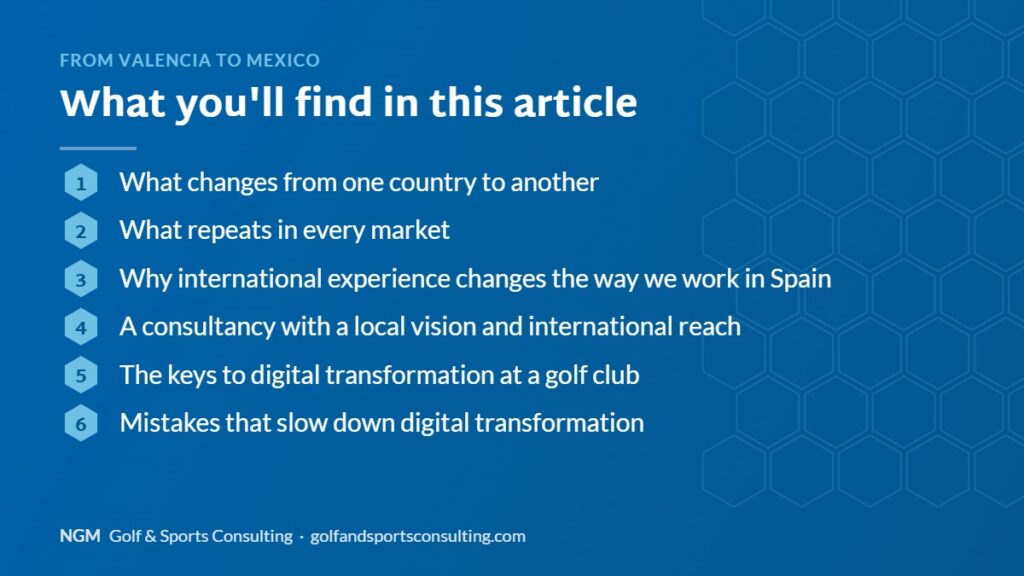
What changes from one country to another
The digital maturity of the average member, the seasonality of the business (very different between coastal golf in Europe and year-round warm-weather golf in the Caribbean or Mexico) and the regulatory framework for data protection or foreign investment are the variables that most shape how a digitalisation project is designed in each market. What works smoothly at a club on the Costa del Sol may need significant adjustments at a resort in Punta Cana or on the Riviera Maya.
What repeats in every market
Regardless of the country, three things always appear: the club team’s initial resistance to changing processes that “have always been done this way”, management’s surprise at seeing on a dashboard data that had not been cross-referenced for years, and a measurable improvement in occupancy and member loyalty in the first twelve months after digitalising bookings and member communication.
Why international experience changes the way we work in Spain
Having managed combined golf, hotel and real estate projects in markets such as Mexico or the Dominican Republic gives NGM a perspective few consultancies focused solely on Spain can offer: understanding how an international member or investor behaves, and how to design a club’s proposition so that it is also attractive to a player or buyer who is not from the area.
A consultancy with a local vision and international reach
This combination (headquarters and operational focus in Valencia, with active projects in six countries) is what allows us to bring every club, whatever its size or location, both knowledge of the local market and a view of what is already working in comparable markets.
These lessons are not only internal: the Royal Spanish Golf Federation itself works actively with federations and bodies in other countries to share good practice, a spirit very similar to the one we apply at NGM Golf & Sports Consulting to digital transformation in golf. Our experience in our golf and real estate investment service across six countries allows us to bring to any Spanish club lessons that would take much longer to arrive in a purely local market, as well as a network of contacts that is especially useful when a project starts looking beyond its usual borders.
That international network is also very useful when a Spanish club starts receiving members or investors from other markets. If you are considering digitalising your club’s management, in Spain or in any of the countries where we operate, we can bring the experience of having already done it in very different contexts. Let’s talk about your project.
The keys to digital transformation at a golf club
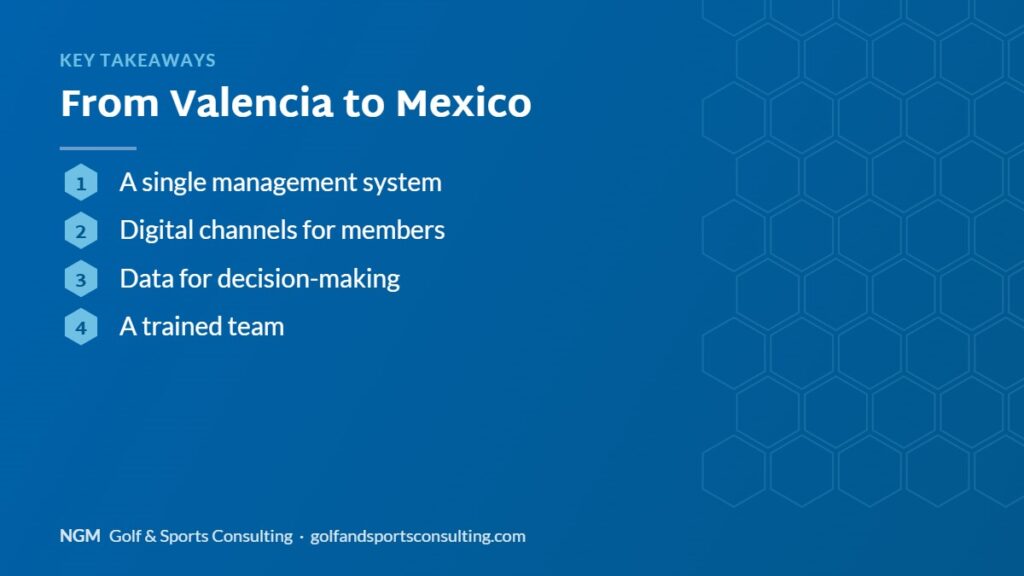
After working with clubs in several countries, we have seen that digital transformation works when it rests on four pillars, regardless of the size of the club or the market:
- A single management system: bookings, members, invoicing and access connected on one platform, so that data is neither duplicated nor lost.
- Digital channels for members: website, app and personalised communications that make it easier to book, pay and stay informed.
- Data for decision-making: a dashboard with occupancy, revenue per player and satisfaction, reviewed every month by management.
- A trained team: technology only adds value if staff understand it and use it every day.
Mistakes that slow down digital transformation
The most repeated mistake is starting with the tool rather than the problem. Many clubs buy software because another course uses it, without first analysing which processes they want to improve. The result is features nobody uses and a team that goes back to spreadsheets.
Another common brake is trying to change everything at once. Digital transformation progresses better in phases: first bookings and the website, then member management, later data and automation. Each phase should have measurable objectives and a clear owner.
We also see projects that forget older members. Digitalising does not mean eliminating personal service, but freeing up the team’s time to devote it to those who need it most. Keeping a face-to-face and phone channel during the transition avoids rejection and improves adoption.

How to measure the success of digital transformation
The indicators that best reflect progress are simple: percentage of online bookings, administrative hours saved per month, response time to enquiries, members’ use of the app and revenue from cross-selling. Reviewing them every quarter makes it possible to correct course and show the board the return on investment.
At NGM Golf & Sports Consulting we support clubs throughout the digital transformation process, from the initial diagnosis to implementation and follow-up, applying what we have learned in Spain, Italy, Portugal, Mexico, Colombia and the Dominican Republic.
Frequently asked questions about digital transformation
Where does a club’s digital transformation start? With a process diagnosis: which tasks take the most time, where data is lost and what members miss.
How long does a digital transformation project take? The first improvements are visible within a few months, but a club’s complete digital transformation is usually planned in phases over one or two years.
Does digital transformation replace staff? No. It eliminates repetitive tasks so the team can spend more time on member service and quality.