

Before any golf investment, it is important to understand exactly what is being bought. A golf course is not valued like any other real estate asset. It combines land, an operating business, a membership base with recurring revenue and, in many cases, associated real estate development potential that can multiply the value of the project if it is managed well, or become a problem if it is ignored.
The operating business before the land
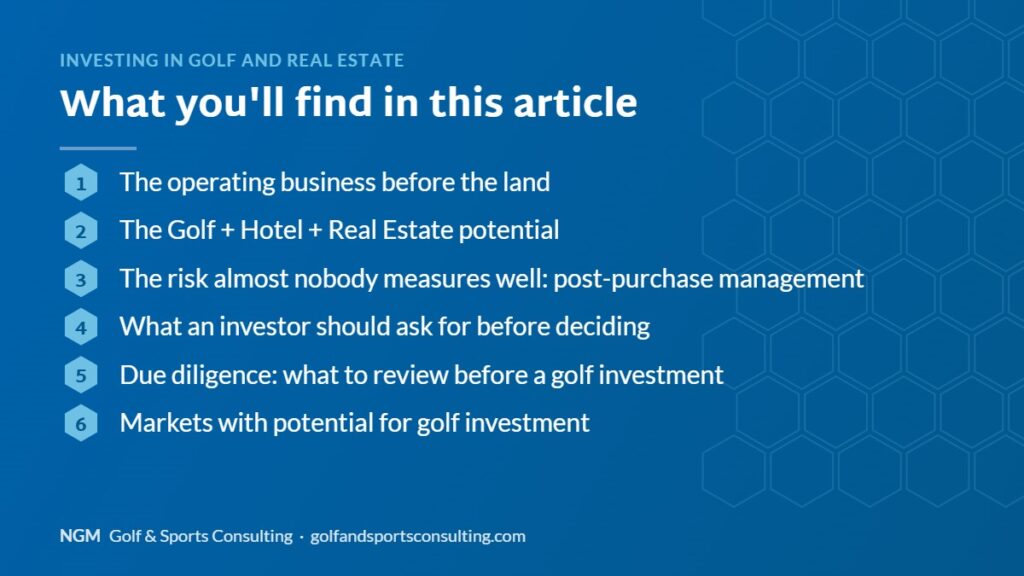
The first common mistake of an investor coming to golf from pure real estate is to look only at the surface area and the location. Before that, the health of the operating business has to be analysed: real course occupancy, average revenue per member, the structure of maintenance costs and the weight of each revenue line (green fees, membership fees, F&B, events), exactly the same indicators we discussed in our article on management KPIs.
The Golf + Hotel + Real Estate potential
In markets such as the Costa del Sol, Mexico, Colombia or the Dominican Republic, much of the value of a golf project lies not only in the course but in its ability to be integrated into a combined golf, hotel and residential development. Assessing that potential correctly requires understanding not only local planning rules, but also the real demand for residential or tourism products linked to golf in that specific location.
The risk almost nobody measures well: post-purchase management
Many golf course acquisitions fail not at the purchase stage but afterwards: a course that is bought well but managed badly quickly loses operating value, while a project with a clear management and digitalisation plan from day one protects and grows that investment from the very first minute. The difference between the two scenarios rarely lies in the purchase price, but in the quality of the subsequent management.
What an investor should ask for before deciding
A comprehensive analysis of the club that combines the physical condition of the course, the legal and planning status of the land, the real operating and financial data of recent years, and a post-acquisition management plan with specific objectives and deadlines. Without these four elements, any golf investment decision is taken with more intuition than information.
The Royal Spanish Golf Federation regularly publishes data on the evolution of the sector in Spain, information any investor should review before considering a golf investment in the Spanish market or in any of the other countries where we operate. At NGM Golf & Sports Consulting we support these processes within our golf and real estate investment service, providing both the analysis of the operating business and the post-purchase management plan, the part that most often determines whether a golf investment ends up profitable in the medium term.
An investor who asks for this data from the first contact usually also avoids costly surprises once the purchase has been completed. That prior discipline almost always makes the difference between a profitable investment and one that ends up making losses.
Due diligence: what to review before a golf investment
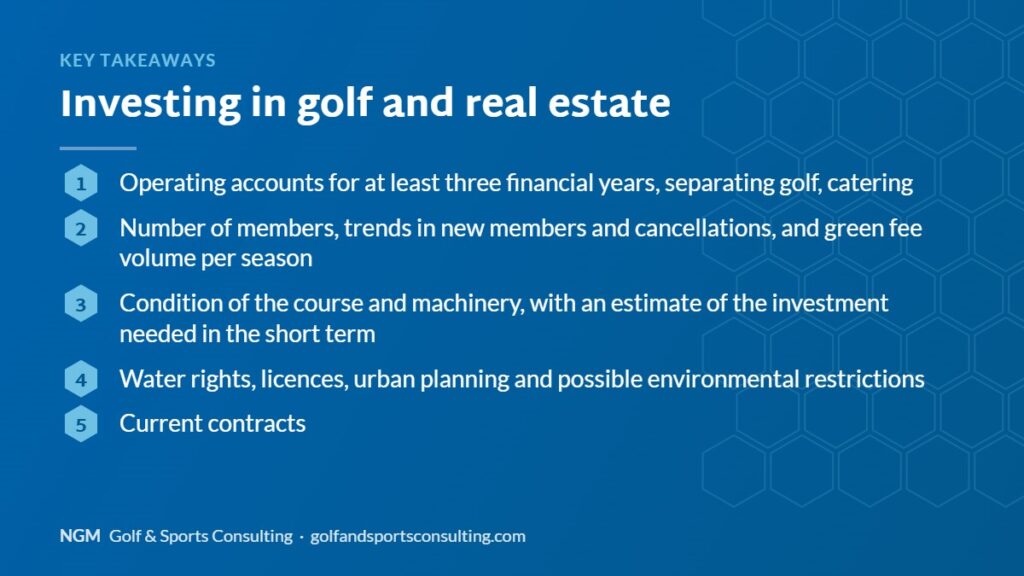
A golf investment requires a more thorough analysis than buying a conventional real estate asset, because the value depends as much on the land as on the business run on it. These are the points we always recommend reviewing:
- Operating accounts for at least three financial years, separating golf, catering, events and other revenue.
- Number of members, trends in new members and cancellations, and green fee volume per season.
- Condition of the course and machinery, with an estimate of the investment needed in the short term.
- Water rights, licences, urban planning and possible environmental restrictions.
- Current contracts: catering concessions, staff, suppliers and agreements with tour operators.
Markets with potential for golf investment
Spain remains one of the most attractive golf destinations in Europe, especially the Costa del Sol, the Valencia region and the islands, thanks to the climate and international demand. Portugal and Italy offer opportunities in projects combined with hotels and high-end residential developments.
Across the Atlantic, Mexico, Colombia and the Dominican Republic combine tourism growth, residential demand and more competitive entry prices. In these markets, the key is to know the local regulations well and to have reliable operating partners.
How to increase the value of a golf investment
Once the asset has been acquired, the return depends above all on management. Digitalising bookings and members, a digital marketing strategy aimed at attracting international players, improving the restaurant and organising corporate events can increase revenue within a few years. Add to that water and energy efficiency, which reduces costs and protects the value of the course in the long term.
At NGM Golf & Sports Consulting we support each golf investment from start to finish: sourcing opportunities, analysing the business, investor relations and the post-purchase management plan, so that the project performs from day one.
Frequently asked questions about golf investment
What return can a golf investment expect? It depends on the model: a course with stable members offers recurring revenue, while projects with a hotel and residential component concentrate the return on home sales and tourist occupancy.
Is it better to buy an operating course or develop a new one? An operating course reduces licensing and construction risk, although it may require additional investment to renovate facilities and modernise management.
What role does management play in a golf investment? A decisive one: professional, digitalised management can completely change a course’s income statement within a few seasons.