

Google Ads is one of the most direct ways to reach golfers who, at this very moment, are looking for somewhere to play. Someone who types “green fee near me” or “golf lessons for beginners” already has the intent; all that is missing is for your course to appear in the right place with the right offer.
Even so, many courses try search advertising, spend budget for a few months and give up with the feeling that “it doesn’t work”. The problem almost always lies in campaign structure and measurement, not in the channel.
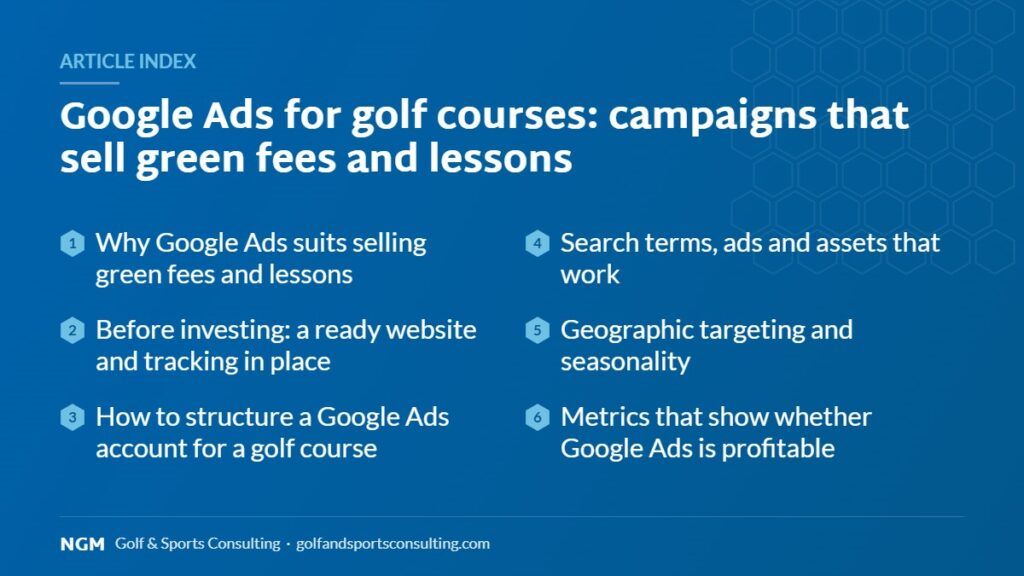
Why Google Ads suits selling green fees and lessons
The main advantage of Google Ads is that it works on existing demand. There is no need to convince anyone that they are interested in golf: the ad appears to people who are already searching for it.
This makes it especially useful for three products at a course, each with its own audience and message:
- Green fees for visiting players and tourists.
- Courses and lessons for beginners, children or companies.
- Events: corporate golf, celebrations or open tournaments.
It also lets you control the budget in detail, pause campaigns when the tee sheet is full and boost them for the time slots or seasons with more gaps. It is advertising that adapts to the course’s real occupancy.
Before investing: a ready website and tracking in place
Sending traffic to a slow website with no clear prices or no online booking is throwing money away. Before switching on Google Ads, check the basics:
- A specific landing page for each product (green fee, course, event).
- Booking or a contact form that is visible and easy to complete on a phone.
- Conversion tracking set up: bookings, submitted forms and calls.
For tracking, the usual approach is to connect the account to Google Analytics and define which actions count as conversions. If the course works with an online booking system, ideally each booking should be attributable to the campaign that generated it.
How to structure a Google Ads account for a golf course
A good structure separates products and search intent. Mixing everything into a single campaign makes it impossible to know what works and where the budget goes.
Brand campaign
Captures searches that include the course’s name. It seems unnecessary, but it protects your position against intermediaries and usually has a low cost with a high conversion rate.
Green fee campaign
Aimed at generic and local searches: “play golf in [area]”, “green fee [city]”. Here it pays to work carefully on location and schedules, and to split by language if the course receives international visitors.
Lessons and academy campaign
Focused on beginners and families, with different messages: accessibility, equipment included, small groups. This audience does not know golf jargon and needs different language. Explain what the course includes, what level is required and what happens afterwards: whether there is a follow-on at the academy or a special rate to keep playing. That continuity is what turns a one-off course into a future season pass holder or member.
Events and corporate campaign
Searches for corporate golf, company events or celebrations. Volume is lower, but each conversion usually has a high value.
Search terms, ads and assets that work
In Google Ads, the choice of search terms makes the difference. Prioritise searches with clear intent and add negative terms to avoid useless clicks, such as “jobs”, “free” or the names of other sports.
Ads should be specific: what you offer, where and why people should choose you. “Green fee with buggy included, 20 minutes from the city” works better than a generic slogan.
Also make use of ad assets: sitelinks to sections (rates, academy, restaurant), click-to-call, location and callouts. They take up more space on the results page and give more reasons to click.

Geographic targeting and seasonality
A golf course does not sell the same way in January as in April, nor to a local player as to a tourist. Google Ads lets you adjust both variables.
For local players, a reasonable radius around the course is usually enough. For tourists, on the other hand, it makes sense to target by country of origin and language, and to launch campaigns ahead of high season, when trips are being planned.
As for seasonality, imagine a course with good weekend occupancy and gaps on weekday afternoons. It makes sense to concentrate spending on ads that promote exactly those slots, with a specific offer, instead of competing for hours that already sell themselves.
Metrics that show whether Google Ads is profitable
The number of clicks or impressions does not tell you whether a campaign is profitable. The metrics that matter are others:
- Cost per conversion: how much it costs to get a booking or a lesson enquiry.
- Conversion value: average revenue generated by each booking, including restaurant or pro shop spending.
- Return on ad spend: attributable revenue compared with the amount invested.
- Impression share: whether the budget is limiting your appearance in profitable searches.
These figures should be reviewed at least weekly in high season and compared with tee sheet occupancy. If a Google Ads campaign fills hours that would have sold anyway, it is not adding real value.
Common mistakes in golf campaigns
Some errors come up again and again at courses that manage their own campaigns:
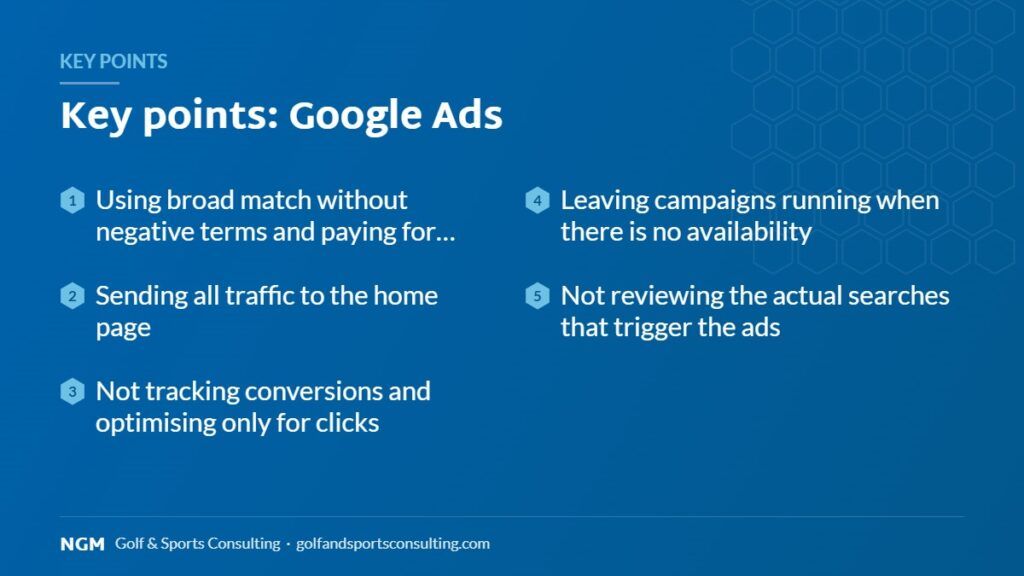
- Using broad match without negative terms and paying for irrelevant searches.
- Sending all traffic to the home page.
- Not tracking conversions and optimising only for clicks.
- Leaving campaigns running when there is no availability.
- Not reviewing the actual searches that trigger the ads.
The Google Ads platform offers automatic recommendations, but review them with judgement: not all of them fit the reality of a golf course or its capacity.
Frequently asked questions about Google Ads
How much budget does a golf course need for Google Ads? It depends on competition in the area, the products being promoted and the goals. The sensible approach is to start with a moderate investment, measure the cost per booking and scale whatever proves profitable.
Does Google Ads replace organic search? No. They complement each other: advertising delivers immediate results, while local SEO builds visibility over the medium term with no cost per click. Ideally, combine both.
Can the club manage Google Ads in-house? It is possible, but it takes time and know-how to review searches, adjust bids and measure properly. Many courses choose outside support that works in coordination with the sales team.
Conclusion: advertising aligned with occupancy
Set up properly, Google Ads becomes a commercial lever the course can activate when needed: to fill gaps, launch a course or reach international tourists. The key lies in structure, measurement and linking advertising to real availability.
At NGM we design and manage campaigns for golf courses and clubs, integrated with their booking system and sales strategy. If you want your advertising spend to work with data, explore our golf club marketing service and let’s talk.