
Buying a golf course is one of those deals that attract people for emotional reasons and, precisely because of that, should be approached with more method than enthusiasm. A golf course is not an ordinary property: it is an operating business with living turf, water, staff, members and a brand built over years.
This guide is written for first-time investors who want to understand what a professional looks at before signing, which awkward questions need asking and which parts of the deal depend on specialist local advisers.
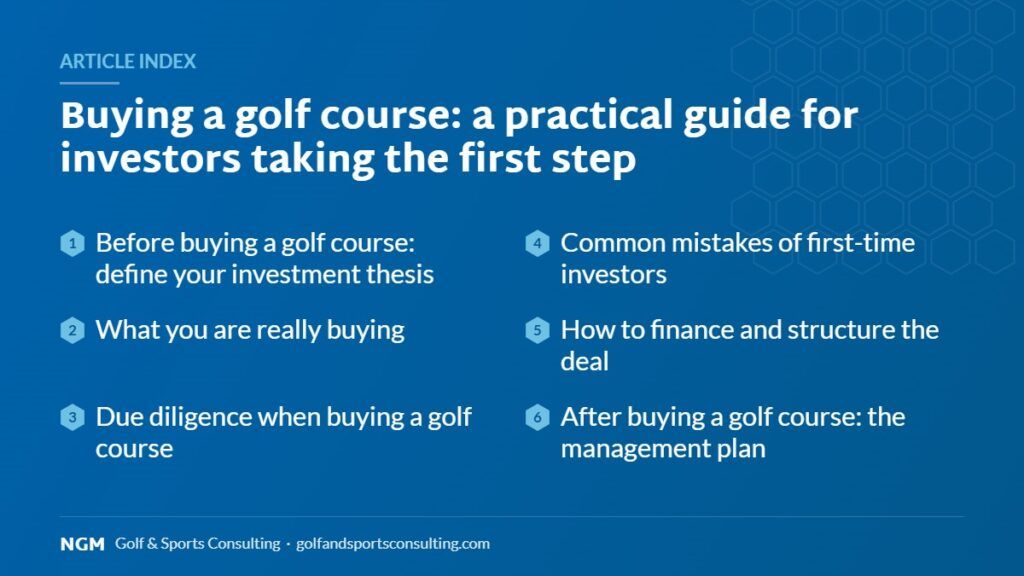
Before buying a golf course: define your investment thesis
When buying a golf course, the most frequent mistake is starting with the asset rather than the strategy. Before visiting any course, write down what you are looking for. Buying a golf course to run it as a stable business is not the same as buying one to drive a real estate development or to reposition it and sell it in a few years.
Your thesis should answer at least these questions:
- Are you looking for recurring income, capital growth or a mix of both?
- Will you manage the course yourself, hire an operator or delegate to a consultancy?
- What is your time horizon and how much additional capital can you commit after the purchase?
- Is golf the core business or an anchor for a hotel, housing or other uses?
With those answers clear, screening opportunities becomes much faster and you avoid falling in love with a course that does not fit your goals.
What you are really buying
When you decide on buying a golf course, you acquire several layers at once, and each one carries its own risk. Separating them helps you value and negotiate better.
The land and its zoning. It determines what you can do today and what you might be able to do tomorrow. Any expectation of building rights must be confirmed with the relevant authority, never only with what the seller says.
The infrastructure. Irrigation system, pumping stations, ponds, drainage, clubhouse, bag room, buggy fleet and machinery. The price often looks attractive because it hides pending investment.
Water rights. In water-stressed areas, the concession or the source of water (wells, reclaimed water, mains supply) can be the most decisive factor in the whole project.
The going concern. Members, contracts, agreements with tour operators, recurring tournaments, food and beverage and the pro shop. This is the part that generates cash, and also the part most likely to bring surprises.
Due diligence when buying a golf course
The review carried out before buying a golf course is the moment to turn hunches into verified data. It is best organised in blocks, with specialists for each one.
Technical review of the course
An independent greenkeeper or agronomist should assess the condition of greens, fairways and bunkers, the quality of irrigation water and the age of the system. Ask for the maintenance and consumption history. Professional bodies such as the Spanish Greenkeepers Association (AEdG), or the equivalent in your country, are a good starting point for identifying qualified technical experts.
Legal, tax and employment review
There are no shortcuts here: activity licences, water concessions, registered charges, member contracts (especially if there are shares or lifetime playing rights), staff and possible contingencies. Every country and region has its own particularities, so local legal and tax advice is essential before buying a golf course.
Commercial and operational review
Analyse the trend in green fees, membership fees, tee sheet occupancy, food and beverage and event revenue. If the data is scattered across spreadsheets or does not exist, that is already telling you something: it points to room for improvement, but also to uncertainty about the starting figure.
Common mistakes of first-time investors
Anyone buying a golf course for the first time tends to stumble over the same obstacles. Knowing them in advance saves money and headaches.
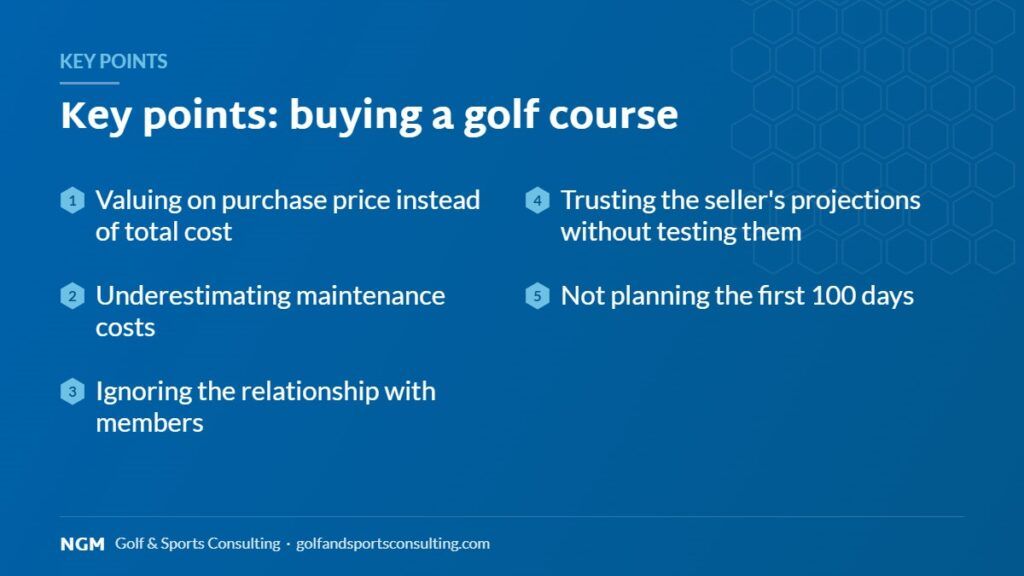
- Valuing on purchase price instead of total cost. Investment in irrigation, machinery or the clubhouse can completely change the return.
- Underestimating maintenance costs. Turf does not care about downturns: it has to be maintained even when visitor numbers fall.
- Ignoring the relationship with members. An unhappy membership can block changes to fees or to the management model.
- Trusting the seller’s projections without testing them. Every growth assumption needs a specific lever to justify it.
- Not planning the first 100 days. The ownership transition is when a lack of systems and team shows most.

How to finance and structure the deal
The structure depends on the size of the asset, the country and your profile. Some deals are set up as asset purchases and others as the acquisition of the company that operates the course. Each option has different implications for tax, liability for past contingencies and continuity of contracts, so the decision must be taken with specialist advisers.
As for financing, banks tend to look cautiously at sports assets because they combine property and business. Presenting a solid business plan, with defensible assumptions and an identified management team, greatly improves the conversation. If the project includes a real estate component, we explain how it fits in our guide to golf and real estate investment.
After buying a golf course: the management plan
The purchase does not end at signing; that is where it begins. The first months shape how members, customers and staff perceive the new owner. Imagine an investor who acquires a well-located course but with phone bookings, manual payments and no reliable customer data: their first value lever is not the turf, but the management.
A reasonable start-up plan usually includes:
- An operational audit and definition of key indicators from the first month.
- Digitalising bookings, access and payments to get reliable occupancy and spending data.
- Transparent communication with members about the new project.
- A review of the food and beverage offer, events and academy.
- An investment calendar prioritised by impact and urgency.
Management tools such as Total Management let you centralise bookings, members and payments, turning intuition into information. If you want to go deeper into improving margins after the purchase, we recommend our article on golf course profitability.
Signs that the opportunity is worth it
There is no single formula, but some signs usually indicate that buying a golf course can make sense:
- A location with local and tourist demand, or the capacity to attract it.
- Long-term guaranteed water and irrigation costs that are reasonable for the area.
- Infrastructure in acceptable condition or with quantified investment needs.
- Clear improvement levers: digitalisation, sales, events or new uses.
- A verified planning and legal framework, with no pending surprises.
If several of these conditions fail, the deal is not necessarily ruled out, but the price must clearly reflect it.
Frequently asked questions about buying a golf course
Do I need golf experience before buying a golf course? It is not essential, but you do need a team or partner who has it. Running a course combines agronomy, hospitality, sport and sales, and a lack of experience is offset by good advisers and management systems.
How long does a purchase take? It depends on the size of the asset, the quality of the available documentation and the complexity of planning and legal issues. Due diligence is the most time-consuming phase and should not be cut short because of pressure from the seller.
What role does a consultancy play when buying a golf course? It helps screen opportunities, coordinate the technical and operational review, build the business plan and prepare the management that follows. Legal and tax matters must always remain in the hands of local lawyers and advisers.
At NGM Golf & Sports Consulting we support investors through the whole process, from analysing the opportunity to launching modern, digital management. If you are considering a deal, tell us about it and let’s review together whether the asset fits your thesis through our golf course investment service.