

Choosing golf club software is one of the longest-lasting decisions a management team can make. It is not replaced every year, it affects every department and it shapes how the team works for a long time. That is why it should be approached as a business project rather than a simple licence purchase. At Total Management, the management software we have developed at NGM, we see every day how a good choice changes the way an entire team works.
In this article we look at how to plan the selection, which criteria really matter, which mistakes we see repeated and which questions you should bring to every meeting with a vendor.
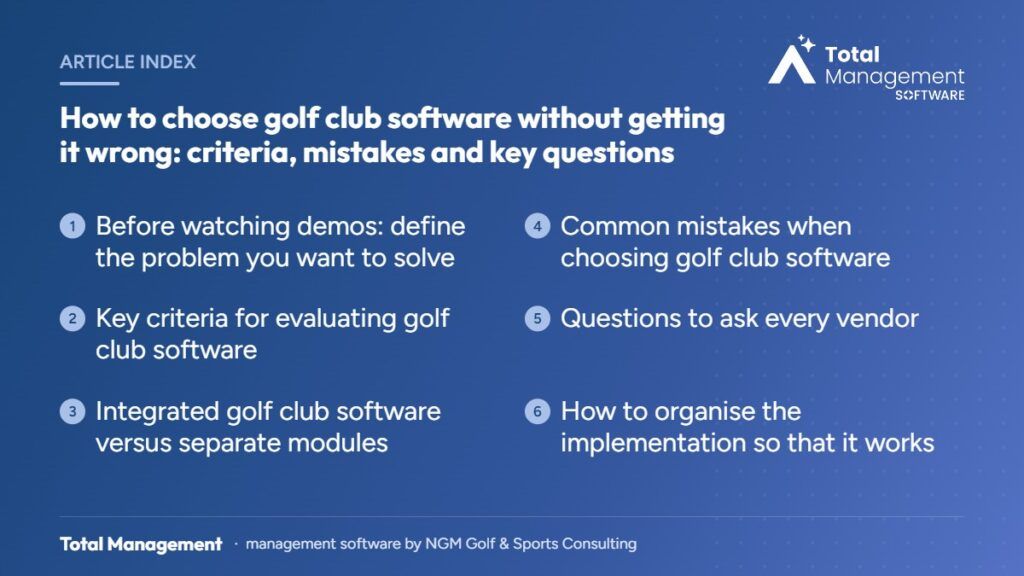
Before watching demos: define the problem you want to solve
The most common mistake is to start with demonstrations. A demo always impresses, but it does not tell you whether the tool fits your club. Before talking to anyone, gather the people in charge of the caddie master’s office, administration, food and beverage, greenkeeping, the academy, the pro shop and sports management, and ask them what takes up most of their time each week.
Their answers will give you a real process map: how bookings are made today, how fees are collected, how access to the course is controlled and which reports are prepared by hand. That map is the yardstick for evaluating any golf club software, and it stops you being swayed by eye-catching features that nobody will use.
Prioritise on three levels: essential, desirable and optional. If a vendor fails on an essential, it is out.
Key criteria for evaluating golf club software
Once your needs are clear, these are the criteria we recommend scoring for each golf club software candidate:
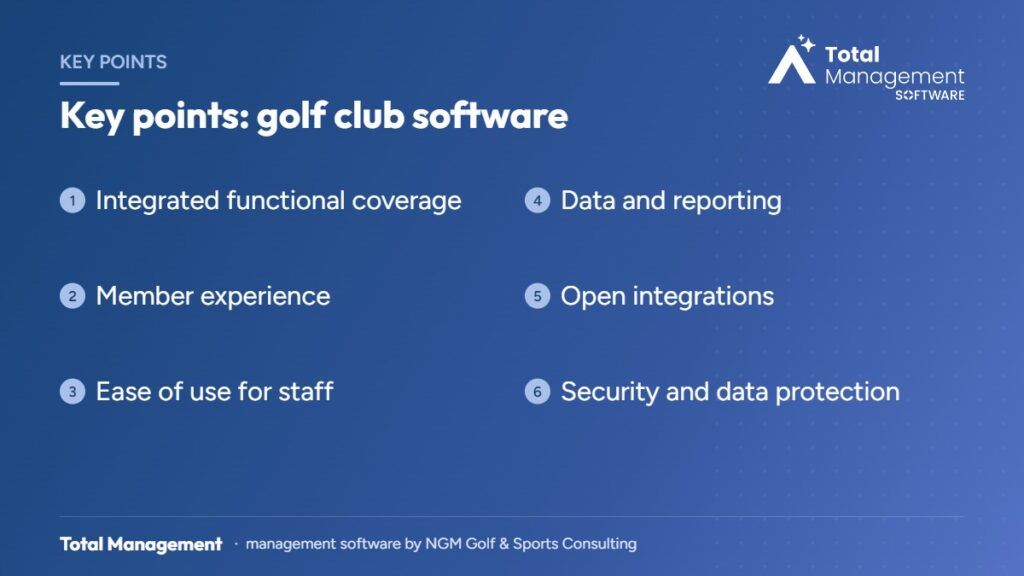
- Integrated functional coverage: bookings and tee sheet, member management, fees and direct debits, access control, restaurant and pro shop POS, and member communication. The fewer separate pieces, the fewer manual reconciliations.
- Member experience: booking from a mobile phone, online payments, notifications and account queries. New-generation members compare everything with the apps they use every day.
- Ease of use for staff: if reception needs ten clicks for a frequent task, the tool will meet resistance.
- Data and reporting: a dashboard with occupancy, revenue by business line and membership trends, without relying on spreadsheets.
- Open integrations: connections with accounting, payment gateways, banks and marketing tools.
- Security and data protection: hosting, backups, user profiles and GDPR compliance.
- Support and implementation: who guides you through the migration, in which language and with what response times.
Give each criterion a weight according to your process map. A club with many visiting green fees will focus on bookings and rates; one with thousands of members, on fees, access and communication.
Integrated golf club software versus separate modules
Many clubs run on a collection of tools: one for bookings, another for invoicing, a standalone POS in the restaurant and spreadsheets to make everything add up. Each may work well on its own, but the hidden cost lies in the gaps between them: duplicated data, errors when transferring information and hours of reconciliation.
Integrated golf club software means a restaurant purchase is charged to the member’s account, a booking is linked to their record and course access automatically checks whether their payments are up to date. That single view of the member is the foundation of any loyalty strategy, as we explain in our article on CRM for golf clubs.
This is the approach behind Total Management: an ecosystem of 16 modules that share the same data, so bookings, fees, access and purchases all live on one platform.
Common mistakes when choosing golf club software
These are the stumbling blocks we see most often in selection processes:
- Deciding on price alone: the licence is only part of the cost. Implementation, training, integrations and staff time weigh as much or more.
- Not involving end users: if reception or administration do not take part, internal rejection is guaranteed.
- Underestimating data migration: member records, fee histories and outstanding balances must be moved across clean. It is worth tidying them up first.
- Signing without an implementation plan: without dates, owners and testing, the project drags on and loses credibility.
- Forgetting mobile: golf club software that does not offer a good mobile experience is outdated from day one.

Questions to ask every vendor
Take the same list to every meeting with golf club software vendors so you can compare answers on equal terms. These are the ones we consider essential:
- What exactly does the fee include, and what is billed separately (modules, users, integrations, support)?
- How does data migration work, and who is responsible for it?
- Where is the data hosted and how is GDPR compliance guaranteed? For regulatory questions in Spain, the reference is the Spanish Data Protection Agency (AEPD), the national supervisory authority.
- Which integrations with accounting, banks and payment gateways are already up and running?
- What is the support response time in high season and at weekends?
- How often is the product updated and how are changes communicated?
- Can we run a trial with our own data and real cases?
Also ask to speak to a club that already uses the system.
How to organise the implementation so that it works
Even the best golf club software fails if the implementation is improvised. This is also how we implement Total Management, and it is the phased plan we recommend:
- Preparation: data clean-up, definition of rates, user profiles and permissions.
- Pilot: start with one specific area, such as bookings, before extending to the rest.
- Role-based training: each position learns only what it needs, using everyday cases.
- Supported go-live: on-site or very close support during the first weeks.
- Review: after a few months, measure usage, incidents and pending improvements.
Communicate the change to members as well. For that part, see our guide to online booking at the golf club.
How to tell whether you chose the right golf club software
After six months you should be able to answer a few questions with data: has the time spent on administrative tasks gone down? Has the share of online bookings grown? Are fees collected with fewer incidents? Does management have up-to-date information without having to ask for it?
Define those indicators before implementation so you have a baseline to compare against. That way the investment in golf club software is judged on results, not impressions.
Golf club software that covers the course, food and beverage and the academy
When assessing functional coverage, do not stop at bookings and fees. A club is also a course to maintain, a restaurant to run and a school to organise. In Total Management, each of these areas has its own module, connected to the same member record and the same data:
- Greenkeeper: course maintenance tasks, machinery, irrigation and treatments.
- Food & Beverage: restaurant, bar and POS, with purchases charged to the member’s account.
- Academy: students, lessons, coaches and courses, all within the same environment.
These are joined by Golf Booking, Access, Tournaments and Data, which brings information from every area together in shared reports. The practical advantage is that nobody types the same data twice and management sees the whole club, not each department separately.
Frequently asked questions about golf club software
How long does it take to implement golf club software? It depends on the size of the club, the number of modules and the state of the existing data. A phased implementation, starting with a pilot area, delivers results early without overwhelming the team.
Is cloud software better than software installed at the club? Cloud solutions make access from anywhere, updates and backups easier. What matters is checking where the data is hosted and what security guarantees the vendor offers.
Can a small club benefit from golf club software? Yes. Even with lower volumes, automating bookings, payments and communication frees up staff hours and improves the member experience from day one.
Total Management brings everything we have covered together on one platform: bookings, members, fees, access, food and beverage, academy and data for management. NGM develops it and implements it, adapting it to the size and priorities of each club. If you are considering new golf club software, discover Total Management and we will show you how it would work at your club.