
Building a golf course budget is much more than copying last year’s figures and adding a percentage. It is the document that sets out what the club wants to achieve over the next twelve months, with which resources and with what margin of error. Done well, it becomes management’s most useful tool; done badly, it is a formality nobody looks at until year end.
Below we propose a six-step method designed for clubs and courses with complex operations: several revenue lines, a large workforce and a board or owner who expects accountability.
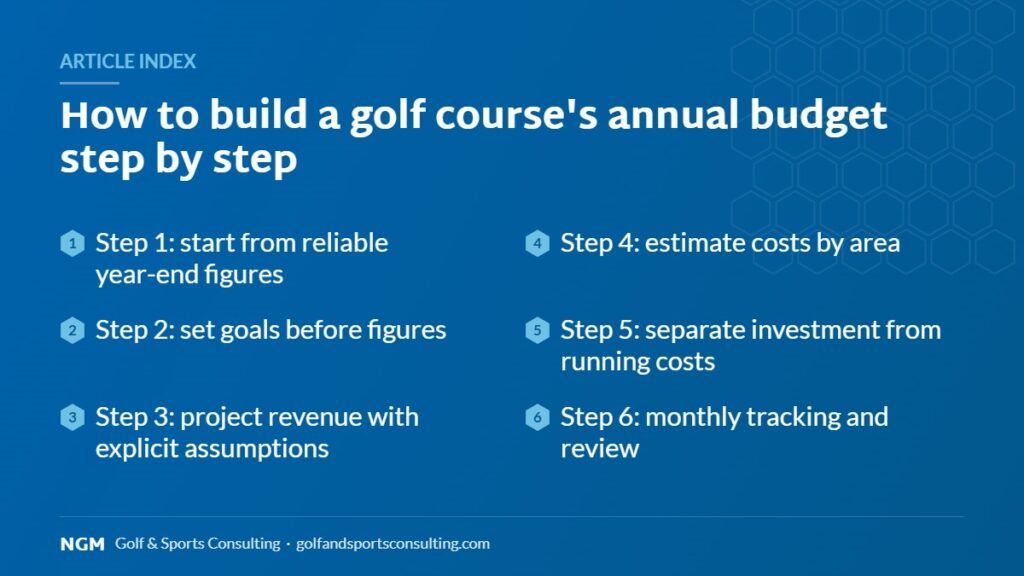
Step 1: start from reliable year-end figures
No budget is better than the information it starts from. Before projecting anything, review last year’s closing figures with three questions:
- Is revenue separated by business line (membership fees, green fees, academy, food and beverage, pro shop, events, sponsorship)?
- Are costs assigned to each area, or does everything fall into a bucket of “overheads”?
- Are there one-off items that distort the comparison, such as a major breakdown or a one-time grant?
If the accounts cannot answer these questions, the first job is to reclassify. Without that step, the golf course budget is built on assumptions nobody can check later.
Step 2: set goals before figures
The budget translates strategy into numbers, not the other way round. Before opening the spreadsheet, management and the board should agree three or four goals for the year. For example: increasing weekday occupancy, improving the condition of the greens, cutting water use or launching a new young member category.
Each goal will be reflected in the golf course budget: in revenue, expenses or investment. So when someone asks why a line has gone up, the answer will be linked to a strategic decision rather than to inertia.
Step 3: project revenue with explicit assumptions
The revenue side of a golf course budget should be built from units, not from totals. Instead of writing “green fees: same as last year”, break it down:
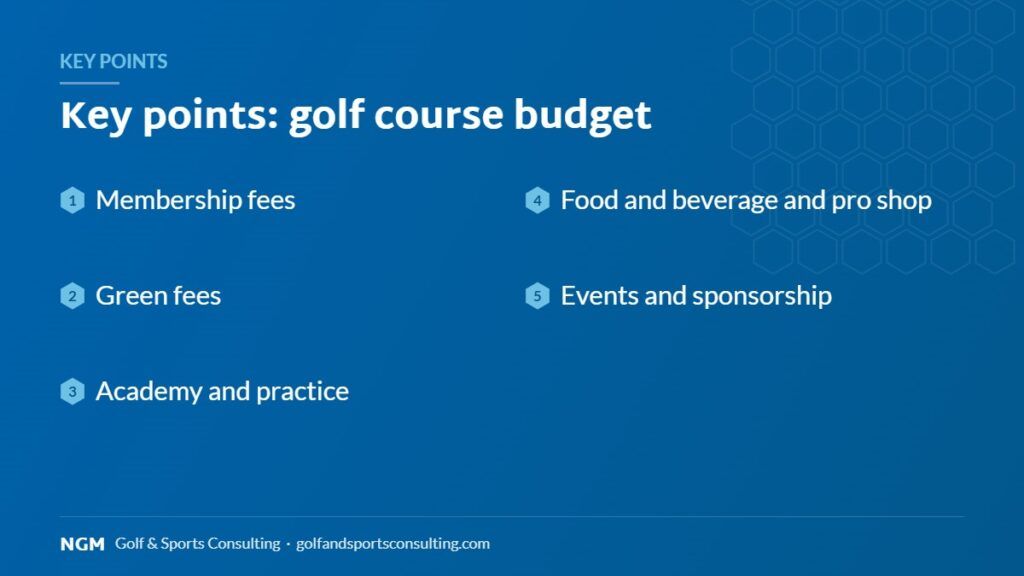
- Membership fees: number of members by category, expected joiners and leavers, and the fee for each type.
- Green fees: expected rounds per season (high, mid, low), average price and the weight of each sales channel.
- Academy and practice: students, lesson hours, range balls sold.
- Food and beverage and pro shop: average spend per visitor and number of visits.
- Events and sponsorship: confirmed tournaments, corporate events and weddings in the pipeline.
Every assumption should be written down. If rounds are below forecast in June, you will know exactly which assumption has failed. A KPI dashboard makes that month-by-month tracking much easier.
Step 4: estimate costs by area
Within a golf course budget, costs are easier to understand when grouped by responsibility centre. In a large club, it is usual to separate at least:
- Course maintenance: staff, water, energy, fertilisers, plant protection products, sand, spare parts and machinery.
- Golf operations: caddie master, reception, buggies, competitions.
- Food and beverage: raw materials, front-of-house and kitchen staff, supplies.
- Overheads: administration, management, insurance, advisers, technology and marketing.
For each area, the person in charge should propose their part and justify it. This involves the team, improves accuracy and makes each manager own their figure. The head greenkeeper, for example, knows better than anyone the calendar of aeration, overseeding and treatments.
Pay special attention to weather-related variable costs, such as water and energy. It is prudent to prepare a base scenario and a tougher one, especially in drought-prone areas. Documenting both scenarios also helps the board understand in advance which decisions would be triggered if the tougher one materialises, such as reducing irrigated areas, postponing a non-urgent purchase or adjusting opening hours in the restaurant during the hottest weeks.
Do not forget the staff costs linked to seasonality either. Summer reinforcements, tournament overtime and holiday cover weigh more than they seem. A golf course budget that spreads them evenly across the year will produce monthly deviations that are hard to interpret, even if the annual total ends up matching.

Step 5: separate investment from running costs
One of the most common mistakes in a golf course budget is mixing the renovation of a tee or the purchase of machinery with ordinary spending. The result is an “expensive” year that is not really expensive, or a “cheap” year that only reflects postponed investment.
The recommended approach is a multi-year investment plan, prioritised by impact and urgency:
- Mandatory: safety, regulations, critical breakdowns.
- Preservation: replacing machinery, the irrigation system, bunkers.
- Improvement: new facilities, digitalisation, social areas.
In the golf course budget, each improvement investment should carry an estimate of its return, even a qualitative one: more rounds, fewer hours of manual work, better member retention.
Step 6: monthly tracking and review
A budget that is only checked at year end is useless for management. The golf course budget should be split by month, reflecting seasonality, and compared with actual figures every month.
The monthly review meeting for the golf course budget does not need to be long. It is enough to go through significant deviations, understand their cause and decide whether they require action. If the situation has clearly changed by mid-year, the sensible thing is to reforecast instead of holding on to a figure that no longer means anything.
This is where technology makes the difference. When bookings, access, payments and sales are integrated in a single system, as happens with Total Management, the management software we work with at NGM, real data is available without waiting for the accounts to close.
Mistakes to avoid in your golf course budget
Imagine a club that budgets for more rounds without planning additional reception and caddie master staff. The revenue arrives, but service gets worse and so do the complaints. It is a hypothetical example, but it illustrates some typical failures:
- Budgeting optimistic revenue and conservative costs at the same time.
- Not including a contingency line for the course.
- Forgetting costs linked to new activities.
- Preparing the budget without input from department heads.
- Not explaining the key assumptions to the board.
To go deeper into improving the club’s results, read our article on golf course profitability.
Frequently asked questions about the golf course budget
When should work on the golf course budget begin? It is sensible to start two or three months before the financial year begins, so that departments can propose their figures and the board has time to review them.
Who should approve it? It depends on the club’s statutes or ownership structure. In member-owned clubs it is usually approved at the general assembly; at privately owned courses, by the owners. Check the club’s internal rules.
What role do industry sources play? Organisations such as the Royal Spanish Golf Federation (RFEG), Spain’s national governing body, publish useful information about the sector, although each club should base its budget on its own data.
If you want your golf course budget to stop being a formality and become a realistic management tool, with clear assumptions and monthly data-driven tracking, NGM can support you throughout the process. Discover our golf course management service and let’s talk about your club.