

The golf course manager is the person who turns the strategy of the board or the owners into daily decisions: who works each shift, what gets invested in the course, how the season is sold and what experience members have from the moment they book until they leave the car park. It is a role that sits between business management, hospitality and the stewardship of a natural asset.
In this article we look at what the job really involves, which profile works best in large clubs and which challenges separate a manager who fights fires from one who actually leads.
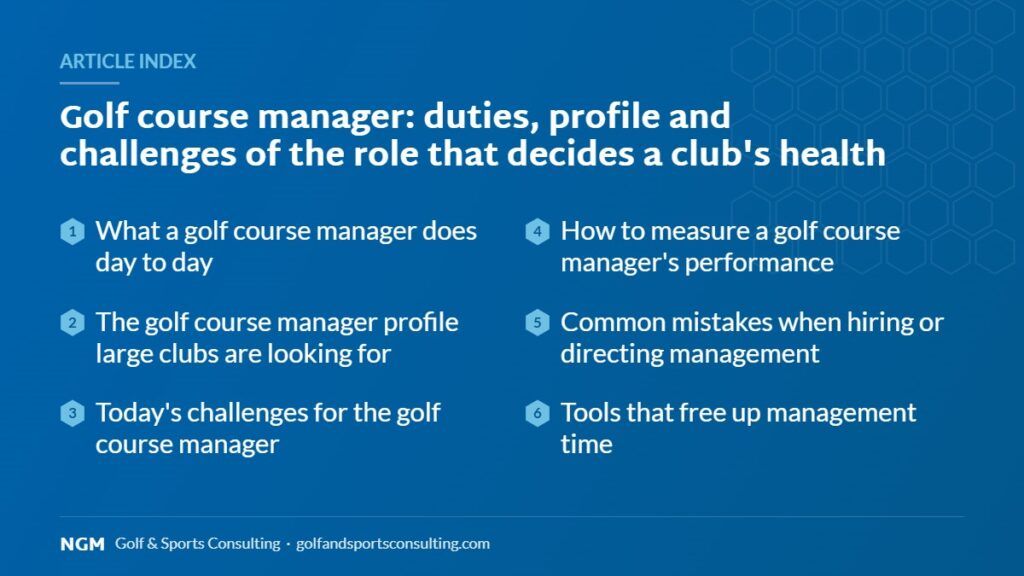
What a golf course manager does day to day
On paper, the duties look clear. In practice, the golf course manager splits the working day between very different tasks that all compete for attention:
- Financial management: preparing and controlling the budget, watching cash flow, negotiating with suppliers and justifying investments to the board.
- Coordinating departments: maintenance, caddie master, reception, academy, food and beverage, pro shop and administration. Each one has its own priorities and its own emergencies.
- Member and visitor experience: bookings, pace of play, handling complaints, communication and events.
- Sales: rates, green fees, season passes, agreements with tour operators and hotels, tournaments and sponsorships.
- Compliance and risk: licences, occupational health and safety, data protection, insurance and relations with public authorities.
The most common mistake is letting operations swallow strategy. If the manager spends the morning sorting out an irrigation problem and the afternoon juggling rotas, nobody is thinking about next quarter’s membership campaign.
The golf course manager profile large clubs are looking for
In clubs with more than 2,500 members, the profile has changed. Knowing the game and getting on well with members is no longer enough. A good golf course manager today combines four blocks of skills.
Business management
Reading a profit and loss account, understanding the margin of each revenue line and knowing how to build an investment case. The board needs someone who can translate sporting decisions into euros and back again.
Leading diverse teams
Greenkeepers, restaurant staff, coaches, administrators and sales people have very different working cultures. The manager has to set shared goals and stop each area from working as an isolated silo.
Technical judgement about the course
There is no need to be an agronomist, but the manager must understand the basics of maintenance, water and turf cycles in order to talk with the head greenkeeper and assess their proposals. Associations such as the Spanish Greenkeepers Association (AEdG) are a good source of training in this area.
Digital mindset
Online bookings, access control, CRM, dashboards and task automation. A golf course manager who does not rely on data ends up deciding by gut feeling or by the last complaint received.
Today’s challenges for the golf course manager
The context has changed a lot in recent years and the role has become more demanding. These are the challenges we see most often when we analyse a club:
- Generational change among members. New members expect to book from their phone, pay without going to reception and receive personalised communication. Long-standing members, on the other hand, value the familiar personal touch. Balancing both is delicate.
- Cost and availability of water. Pressure on water resources forces clubs to plan irrigation, look for alternative sources and explain decisions well.
- Tight margins. Energy, staff and supplies make operations more expensive, and not everything can be passed on to membership fees.
- Legacy manual processes. Spreadsheets, paper lists and phone bookings eat up hours that add no value.
- Pressure from the board. Short terms of office and shifting expectations make multi-year plans difficult.
For the golf course manager, the common denominator of all these challenges is time. Every hour spent on repetitive tasks is an hour not spent improving the club.
How to measure a golf course manager’s performance
Judging management on impressions creates conflict. The best approach is to agree a small set of indicators with the board and review them every month. Some of the most useful are:
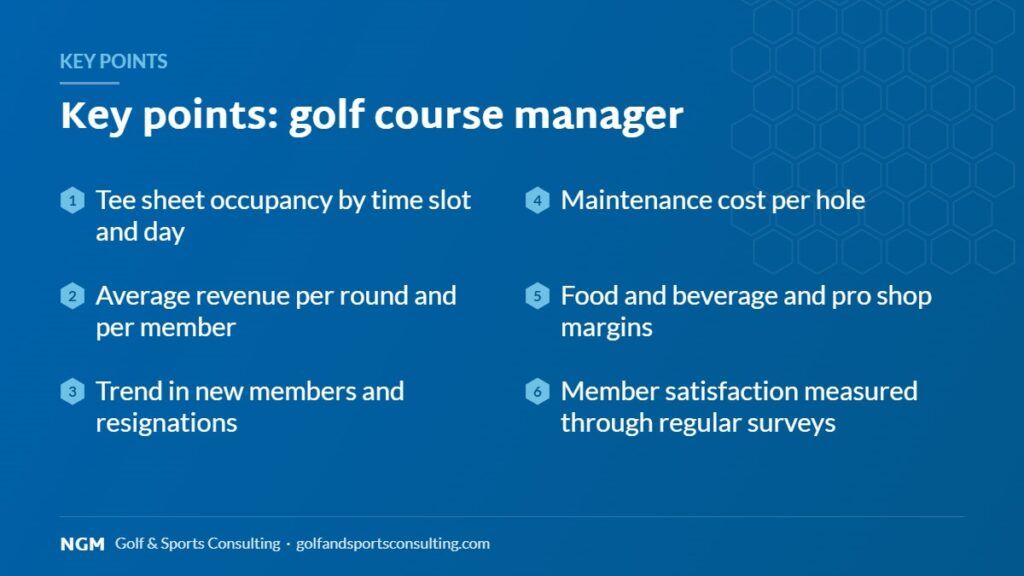
- Tee sheet occupancy by time slot and day.
- Average revenue per round and per member.
- Trend in new members and resignations.
- Maintenance cost per hole.
- Food and beverage and pro shop margins.
- Member satisfaction measured through regular surveys.
A well-designed KPI dashboard lets the golf course manager present objective results and lets the board discuss data, not opinions. It also helps spot deviations early; if they are only discovered when the year closes, it is too late to fix them.

Common mistakes when hiring or directing management
Imagine a club that hires a manager with an impressive sporting background but no experience in financial management. For the first few months everything goes well: the atmosphere improves and members are happy. A year later, costs have soared and nobody can explain why. It is a hypothetical case, but it reflects patterns that repeat themselves:
- Hiring on rapport alone: closeness to members matters, but it does not replace management ability.
- Not putting the mandate in writing: what the golf course manager decides and what the board decides. Without that boundary, friction appears.
- Not providing tools: asking for results without information systems or a budget to digitalise.
- Changing direction with every new board: improvement plans for a course need several financial years.
- Isolating the manager from the team: a manager who is not involved in daily operations loses touch with the club.
Tools that free up management time
Technology does not replace the manager, but it does take away tasks that do not need their judgement. In large clubs, the improvements with the greatest impact are usually:
- Online bookings and a digital tee sheet, which cut phone calls and errors. We explain this in detail in our article on online booking for golf clubs.
- Automated access control, which knows who comes in, when and with what entitlement.
- Member CRM, to segment communications and anticipate resignations.
- Automatic reports, which reach the board without anyone having to put them together by hand.
At NGM we work with Total Management, our management software, with exactly this logic in mind: the golf course manager has real-time information and can spend their time deciding, not collecting data.
In-house management or external support
Not every club needs the same thing. Some have a solid manager who only needs occasional support with digitalisation or marketing. Others are going through a period of change, such as a new board, a drop in membership or a major investment, and benefit from external management that brings method and experience from other courses.
A middle-ground model that works well is ongoing support: the golf course manager keeps control of daily operations while the consultancy provides analysis, strategic planning, tools and regular reports for the board. This strengthens the manager’s position instead of replacing it.
Frequently asked questions about the golf course manager
What training does a golf course manager need? There is no single path. The usual route combines studies in business administration or tourism with experience in clubs and specific courses in sports management and course maintenance.
What is the difference between a manager and a sports director? The golf course manager is responsible for the overall running of the club, including finances, while the sports director focuses on competition, the academy and playing activity.
When does it make sense to bring in a consultancy? When the club faces a significant change, sees losses without a clear cause or wants to digitalise without disrupting operations. An outside view helps set priorities and measure progress.
If you want to strengthen your club’s management with method, data and digital tools, NGM can help. Find out how we approach golf course management and tell us where your club stands.