

Collecting green fees, lessons, tournament entries or extraordinary levies in cash or by manual bank transfer is becoming less and less common. Players and members expect to pay from their phone when they book, and the club needs that money to arrive reconciled and without extra work. The piece that makes this possible is the payment gateway.
At Total Management, the management software we have developed at NGM, online payments are part of running the club, not an add-on. Choosing the right gateway is not just a technical matter. The buying experience, data security, transaction costs and the time administration spends reconciling payments all depend on it. In this article we look at how to approach the decision and how to implement it smoothly.
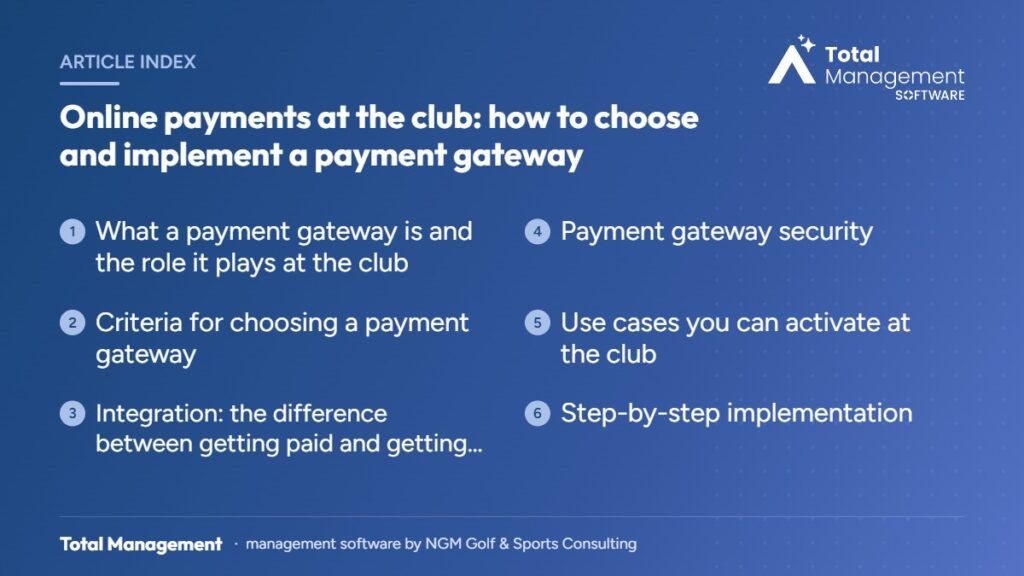
What a payment gateway is and the role it plays at the club
A payment gateway is the service that processes card payments and other electronic methods in an online environment: website, app or a link sent by email or messaging. It verifies the transaction with the issuing bank, applies cardholder authentication and deposits the amount in the club’s account.
At a golf club, online payments appear in many places: visitor green fee bookings, tournament entries, academy courses, buggy hire, padel passes, event tickets or wallet top-ups. If each one is collected through a different channel, reconciliation becomes extremely complicated.
Criteria for choosing a payment gateway
Not all options are equal. These are the criteria we recommend assessing before signing:
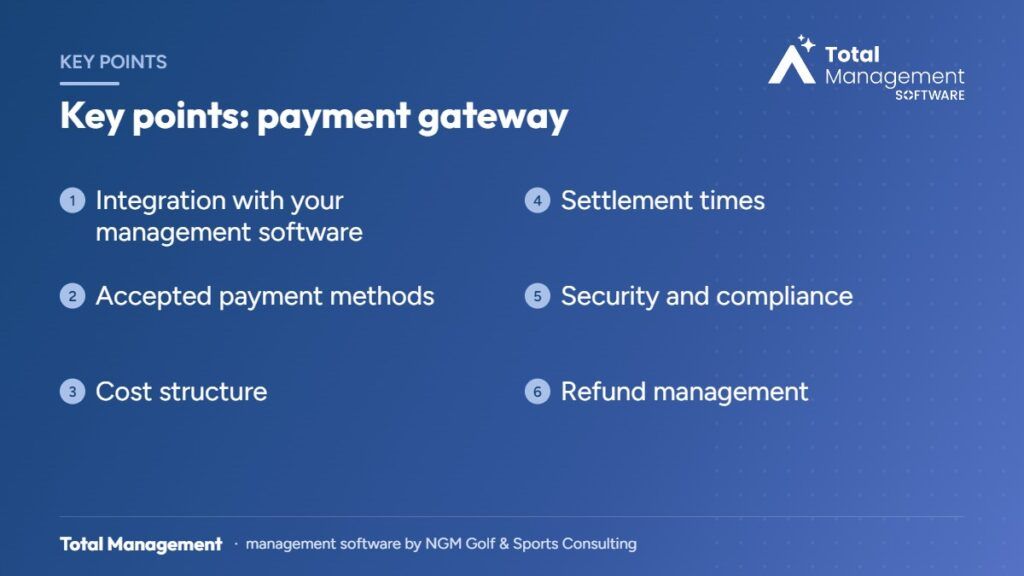
- Integration with your management software: this is the number one criterion. The payment gateway must connect with bookings, member records and accounting so that each payment is automatically linked to what it pays for.
- Accepted payment methods: cards, mobile payments and, if you receive international players, support for different currencies.
- Cost structure: per-transaction fees, fixed charges, and the cost of refunds and chargebacks. Ask for the details in writing.
- Settlement times: how many days it takes for the money to reach the club’s account.
- Security and compliance: strong customer authentication, tokenisation and card industry certifications.
- Refund management: how easy it is to refund all or part of an amount from within the system.
- Support: service in your language and response times when something goes wrong.
Integration: the difference between getting paid and getting paid well
Many clubs have a payment gateway that works but is disconnected from everything else. The player pays on the website, administration receives an email with the amount and someone records it by hand in the booking system and in accounting. Every manual step is lost time and a risk of error.
With full integration, the flow changes: the player books a tee time, pays in the same process, the booking is confirmed and marked as paid on the tee sheet, and the payment is posted to accounting with its description. If a cancellation falls within the deadline, the refund is issued from the system itself. This is the flow we aim for with Total Management: booking, payment and customer record all within the same system.
If you want to go deeper into the booking process, we explain it in our article on online booking for golf clubs.
Payment gateway security
Security is non-negotiable. The club should never store full card details in its own systems; that responsibility belongs to the payment gateway provider, which uses techniques such as tokenisation to store a reference instead of the real number.
In Europe, payment services regulation requires strong customer authentication for many online transactions. A good payment gateway handles it transparently, without adding unnecessary friction. For official information on payment services in Spain, the Bank of Spain, the country’s central bank, is a useful reference, although details should be checked with your bank and adviser.
Also review the protection of personal data linked to payments, a topic we cover in our guide to data protection at the golf club.

Use cases you can activate at the club
Once integrated, the payment gateway opens up possibilities that go well beyond the green fee:
- Prepaid bookings in high-demand slots to reduce no-shows.
- Tournament registration and payment in a single step, with no paper lists.
- Academy and summer camp enrolment, with instalment options if your provider allows it.
- Member wallet: online top-ups to spend in the restaurant or pro shop.
- Payment links sent by email or messaging for one-off charges, such as private events.
- Sale of passes and memberships from the website or the app.
Imagine, for example, a club selling beginner lessons. If the prospect can choose a date and pay at that very moment, conversion is usually higher than if they have to phone, wait for an email and make a transfer.
Step-by-step implementation
To keep the rollout orderly, we recommend these phases:
- Payment inventory: list everything you charge for today and through which channel.
- Provider selection based on the criteria above and compatibility with your software.
- Configuration: items, taxes, cancellation and refund policies, legal texts and receipts.
- Testing in a test environment with real cases: successful payment, declined payment, partial refund, cancellation.
- Gradual launch, starting with a specific service such as visitor green fees.
- Monitoring of indicators during the first months.
With Total Management, this configuration is done in the same environment that already holds bookings and members, which simplifies testing. Train reception and administration staff to handle the most common questions: duplicate payments, pending charges or refunds.
Indicators to measure payment gateway success
After go-live, keep an eye on a few figures: percentage of bookings paid online, declined payment rate, number of refunds and chargebacks, average cost per transaction and time spent on reconciliation. If declined payments are high, review the mobile experience and the payment methods available.
Another revealing indicator is drop-off at the payment step: players who start a booking and do not complete it. If it happens often, check how many steps there are between choosing a time and confirming, whether the form asks for unnecessary data and whether the page loads well on slow connections, which is common when people book from the club car park.
Finally, compare the share of online versus in-person payments quarter by quarter: a growing trend shows that the payment gateway has become part of members’ and visitors’ habits.
Connected payments: from green fees to food and beverage and the academy
A payment gateway really pays off when every payment at the club ends up in the same place. In Total Management, online payments do not stay in Golf Booking: they are linked to the member or customer record managed by the Management module and reflected in the Data reports.
The same logic applies to other areas of the club:
- Academy: enrolments, courses and lessons paid online and linked to each student.
- Food & Beverage: wallet top-ups and restaurant purchases that can be checked in the member’s account.
- Tournaments: entries paid and recorded in the competition.
Even Greenkeeper benefits indirectly: when course maintenance forces holes to close or tee times to be cancelled, the affected bookings and their refunds are handled from the same environment, with no phone calls or spreadsheets.
Frequently asked questions about the payment gateway
Can I use my bank’s payment gateway? Yes, as long as it integrates well with your management software. What matters is not who provides it, but that payments are reconciled automatically.
Can a payment gateway also be used to collect member fees? It can be used for one-off payments or top-ups, but for recurring fees the usual approach is bank direct debit through SEPA batches, which tends to be more efficient.
What happens if a player cancels a booking that has already been paid? It depends on the cancellation policy you define. With proper integration, the refund is processed from within the system and recorded.
Total Management integrates online payments with bookings, member records, the academy, food and beverage and tournaments, so every payment arrives reconciled and correctly labelled. NGM, which developed it, supports you through configuration and go-live. If you want your payment gateway to work within a single system, discover Total Management and we will look at your case.