

Attracting women golfers is one of the clearest growth opportunities for any club that wants to broaden its player base. Yet many clubs still design their offer, schedules and communication around one very specific type of player, and then wonder why women who try golf never quite get hooked.
Attracting female players is not about printing a pink brochure or holding one tournament a year. It means reviewing the whole experience: how a woman reaches the club, what she finds in her first lesson, who she plays with afterwards and whether she feels part of the community.
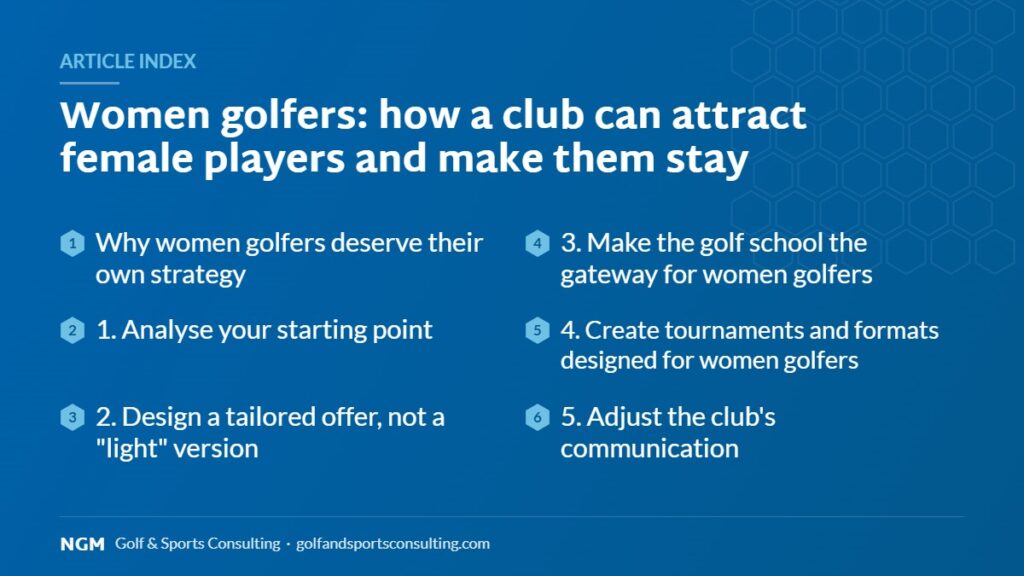
In this article we go through seven practical keys so that women golfers stop being a token segment and become a driver of members, students and activity for the club.
Why women golfers deserve their own strategy
There are several business reasons. Female players expand the club’s potential market at a time when recruiting new members is increasingly costly. They also tend to bring others along: friends, partners, children. A woman who falls in love with golf can turn a whole family into club users.
There is also an image argument. A club with an active group of women golfers conveys modernity, openness and a social atmosphere, exactly what many new-generation players look for. For the federation context and existing promotion programmes in Spain, the Royal Spanish Golf Federation (RFEG, Spain’s national governing body) is the natural reference.
1. Analyse your starting point
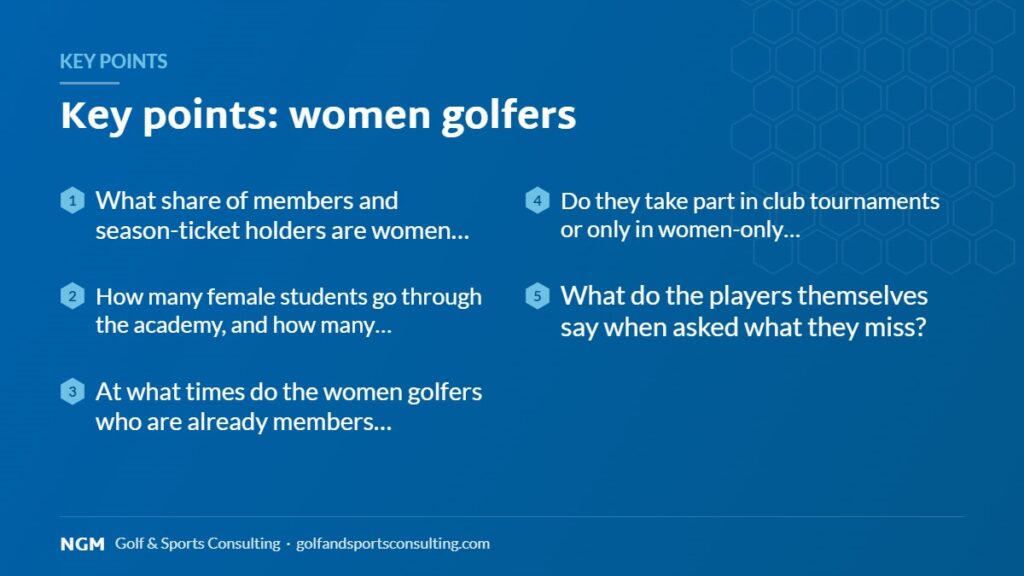
Before launching actions, it is worth knowing where the club stands. Some useful questions:
- What share of members and season-ticket holders are women, and how has it evolved?
- How many female students go through the academy, and how many are still playing a year later?
- At what times do the women golfers who are already members play?
- Do they take part in club tournaments or only in women-only events?
- What do the players themselves say when asked what they miss?
With these answers, your plan for women golfers is based on the club’s own data rather than assumptions.
2. Design a tailored offer, not a “light” version
The most common mistake is creating watered-down products. What works is adapting format, timing and support:
- Schedules that fit work and family life: lunchtime, early afternoons on weekdays, weekend mornings with parallel activities for children.
- Introductory fees that let people try without committing to a full annual membership, with a clear path to becoming a member.
- Combined packages of lessons, driving range access and accompanied rounds.
- Equipment available to borrow or rent for the first few weeks, so nobody has to buy clubs before knowing whether the sport is for them.
3. Make the golf school the gateway for women golfers
The academy is where a new player is won or lost. Small groups, similar levels and a professional who knows how to teach adult beginners make the difference.
A good practice is to create women-only beginner groups for those who prefer them: many women learn with more confidence in a pressure-free environment. Later, these groups can be integrated with other students. If the club is reviewing its model, it is worth looking at how to structure a golf school with clear learning paths.
The critical moment is the move from lesson to course. Without an accompanied round, many students stay on the range and eventually give up. Organising 9-hole “first rounds” with a professional or an experienced member solves a large part of the problem.
4. Create tournaments and formats designed for women golfers
Tournaments are the social glue for women golfers. But not every format works. An 18-hole medal play championship is intimidating for someone who has just obtained a handicap.
Formats that usually work better:
- 9-hole tournaments in the afternoon, with drinks or dinner afterwards.
- Pairs formats (greensome, foursome, scramble) that reduce individual pressure.
- Internal leagues with monthly rounds and cumulative rankings, which build a habit.
- Themed clinics (short game, rules, strategy) followed by a round.
Including them in the club’s events and tournaments calendar, with the same visibility as the main competitions, sends a clear message that women golfers are a priority.

5. Adjust the club’s communication
Many club websites and social media feeds almost always show the same type of player. If a woman does not see herself represented, she is less likely to think that club is for her.
Practical recommendations when communicating with women golfers:
- Feature real female players from the club (with their consent) in photos and videos, playing, practising and enjoying the social side.
- Create a dedicated section or landing page with the introductory offer, schedules and a simple contact form.
- Tell stories: the member who started two years ago, the group of friends who signed up together, the player who won her first tournament.
- Use the club’s social media to give continuity to leagues and events, not just to announce them.
- Avoid stereotypes: the tone should be the same as for any player, sporty and approachable.
6. Build a community of women golfers that sustains itself
Loyalty comes when a player has people to play with. A WhatsApp group or a channel in the club app to organise games, a captain or coordinator for the group and regular social gatherings ensure the activity does not depend solely on club staff.
Imagine a club that, after a beginner programme, organises a monthly 9-hole outing followed by lunch. After a few months, the women golfers themselves propose dates, invite friends and ask for their own tournament. That is the point at which the group starts to grow organically.
7. Measure and adjust the plan
Like any marketing action, the plan needs indicators:
- Leads received from the landing page and campaigns.
- Conversion from trial lesson to course, and from course to member or season-ticket holder.
- Retention of new women golfers at six and twelve months.
- Participation in tournaments and leagues.
- Spending in other areas of the club (restaurant, pro shop, events).
Reviewing these figures every quarter shows which actions bring players who stay and which only generate one-off visits.
Frequently asked questions about women golfers
Is it necessary to create women-only groups? It is not mandatory, but offering the option at beginner level usually makes it easier for new women golfers to get started. What matters is that they are later naturally integrated with the club’s other players.
What budget does a club need to attract women golfers? It depends on the starting point. Many actions (schedules, tournament formats, communication) require more organisation than investment; the essential thing is that someone at the club takes on coordination.
How long does it take to see results? The first students arrive quickly if the offer is well communicated, but the community is consolidated through consistency. A plan for women golfers should be designed for at least one full season.
If you want to design a plan to attract and retain female players, with an aligned offer, communication and campaigns, NGM can help you put it into practice. Discover our golf club marketing service.