

Email marketing is still one of the most profitable channels for a golf club, as long as it is done with judgement. The problem is not the channel but how it is used: generic newsletters sent to the whole database, with ten news items mixed together and no clear reason to click.
In this article we look at how to plan email marketing for a golf club or course so that members open the emails, read them and, above all, act on them: book a tee time, enter a tournament or reserve a table at the restaurant.
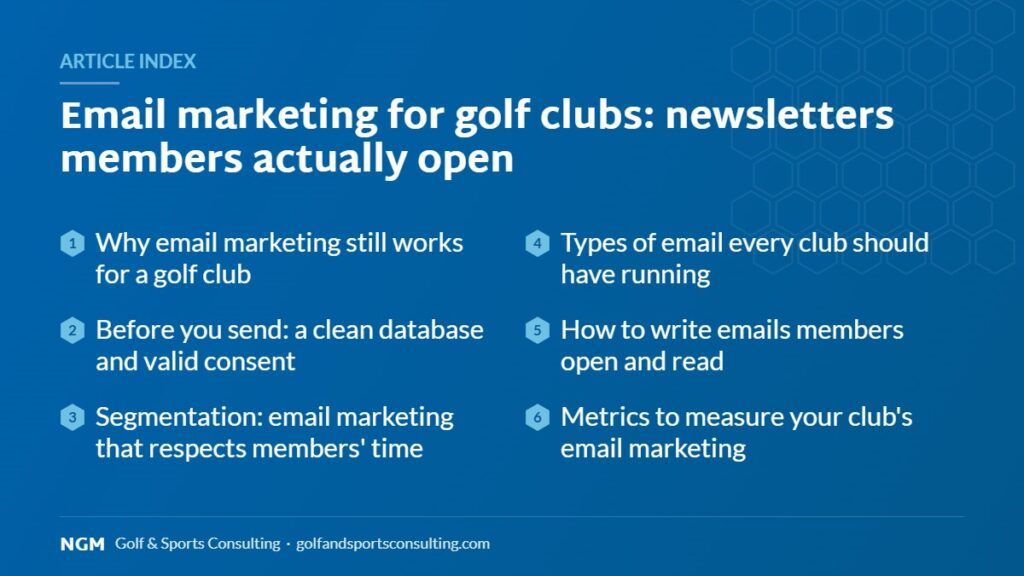
Why email marketing still works for a golf club
Unlike social media, where reach depends on an algorithm, email lands in an inbox the club can rely on. The relationship with the member is direct and the database is an asset the club owns.
The profile of a typical golf member also fits this channel very well: they check email every day, value practical information and expect their club to keep them up to date on competitions, opening hours and news. Email marketing makes the most of that habit.
Finally, it is measurable. Every send produces data on opens, clicks and conversions that let you adjust the strategy month after month, something traditional channels such as the notice board or posters in the clubhouse cannot offer.
Before you send: a clean database and valid consent
No campaign works on a messy list. Before thinking about design, it is worth reviewing three things:
- Data quality: duplicate emails, wrong addresses or former members who still receive communications.
- Consent: every contact must have a clear legal basis for receiving commercial communications under the GDPR, the EU data protection regulation. If in doubt, check the guidance of the Spanish Data Protection Agency (AEPD), your local regulator, or a specialist adviser.
- Useful data for segmentation: membership type, handicap, language, how often they play, tournament participation or use of other services.
If the club works with integrated management software, much of this information already exists. We cover it in our article on CRM for golf clubs, which is the foundation of any serious email marketing strategy.
Segmentation: email marketing that respects members’ time
The most common mistake is sending the same email to everyone. A senior member who plays on weekdays does not need the same information as a family interested in the junior academy or a visiting player who comes twice a year.
Some segments that usually work well in a golf club:
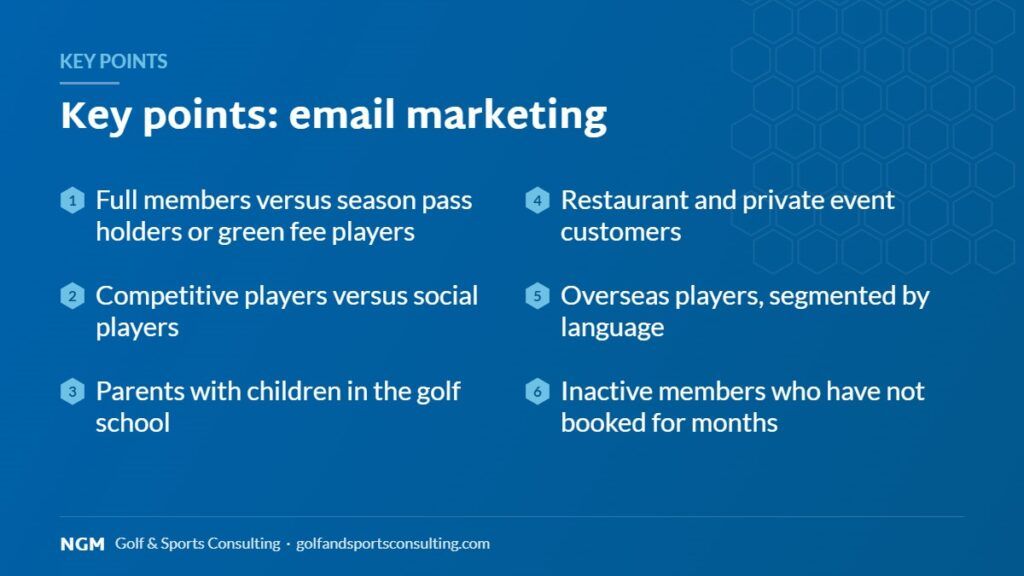
- Full members versus season pass holders or green fee players.
- Competitive players versus social players.
- Parents with children in the golf school.
- Restaurant and private event customers.
- Overseas players, segmented by language.
- Inactive members who have not booked for months.
With these groups, email marketing stops being a general newsletter and becomes a service: each person receives what interests them. You notice it in the open rate and, above all, in the unsubscribe rate.
Types of email every club should have running
A complete email marketing strategy combines regular emails with automated sends. These are the ones that should not be missing.
Regular newsletter
A monthly or fortnightly newsletter with a few well-chosen items: upcoming tournaments, notable results, course news and one concrete offer. Three relevant pieces are better than ten that nobody finishes reading.
Transactional emails
Booking confirmations, tee time reminders, notices of changed hours due to maintenance. They are not usually considered email marketing, but they are the most opened emails and a good opportunity to add a useful recommendation.
Automations
A welcome for new members, a birthday greeting with an invitation, a reminder to someone who has not played for a while or a survey after a tournament. You set them up once and they work on their own all season.

How to write emails members open and read
The subject line decides whether the email gets opened. It should be specific and give a clear reason: “12 places left for Saturday’s tournament” works better than “October newsletter”. Avoid capital letters and too many exclamation marks.
The sender also matters. A recognisable name, such as the manager’s or the caddie master’s, builds more trust than a generic address.
In the body, the rule is simple: one main goal per email, one visible call to action and short copy. Most members will read the email on their phone, so the design must work on small screens and buttons must be easy to tap.
Finally, watch the tone. A club’s email marketing is not an online shop’s: the member is part of a community and expects a friendly, informed approach without constant sales pressure.
Metrics to measure your club’s email marketing
Measurement is what turns email marketing into a management tool. These are the metrics worth reviewing after every send:
- Open rate: gives an idea of how interesting the subject line and sender are, although it is less precise today because of privacy features in some email clients.
- Click-through rate: shows whether the content and call to action work.
- Conversions: bookings, entries or sales attributable to the email. This is the most important figure.
- Unsubscribes and complaints: if they rise, something is wrong with frequency or relevance.
Ideally, these figures should sit in the club’s KPI dashboard alongside tee sheet occupancy and revenue by service. That way you can clearly see what email marketing contributes to the business, not just how many people open the emails.
Common mistakes to avoid
Imagine a club that sends a weekly email to the whole database, always in the same format and with the full calendar of activities. At first people open it; a few months later, hardly anyone does. The channel has not stopped working: it has become noise.
Other frequent mistakes:
- Sending only when there is something to sell.
- Not checking how the email looks on a phone before sending it.
- Forgetting the unsubscribe link or hiding it.
- Not testing different subject lines to learn what works.
- Relying on one person who sends emails “when they can”, with no calendar.
A simple editorial calendar, aligned with the competition season and club events, solves most of these problems.
Frequently asked questions about email marketing
How often should a golf club send emails? It depends on the segment and the club’s activity, but a monthly or fortnightly newsletter, plus automated sends, is usually a good starting point. The key is that every send has a reason to exist.
What tool do I need for email marketing at my club? Ideally, the sending tool should be connected to the club’s management software, so you can segment with real booking, fee and activity data without exporting lists by hand.
Does email marketing also help attract new members? Yes, especially for nurturing contacts who have shown interest: green fee players, event guests or families who have asked about the academy. With a well-designed sequence, you guide them towards a visit or a trial. Our guide to attracting new memberships goes deeper into this.
Conclusion: from newsletter to relationship channel
Good email marketing is not measured by the number of emails sent, but by the relationship it builds with each member and the bookings it generates. A clean database, segmentation, automations and measurement: with these four pillars, email becomes a channel members look forward to again.
At NGM we help golf clubs and courses design and run their digital communication strategy, integrated with their management software. If you want to go a step further, discover our golf club marketing services and let’s talk about how to apply it to your club.