

Golf course valuation is one of the most delicate tasks in the industry. Unlike an office or a home, comparing square metres is not enough: value depends on how the business performs, the quality of the course, the water available and what the land will allow in the future.
Whether you plan to buy, sell or seek financing, understanding the methods and factors involved will help you negotiate with solid arguments and spot prices that do not hold up.
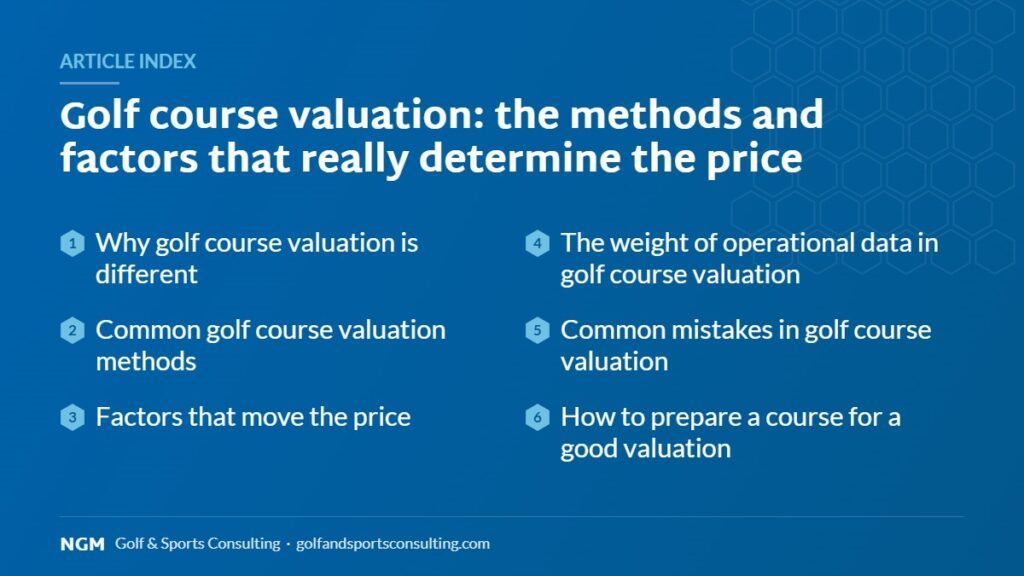
Why golf course valuation is different
A golf course is at once a property, a sports facility and a service business. That is why a golf course valuation combines different logics: the real estate logic, which looks at land and buildings, and the business logic, which looks at the capacity to generate cash.
There are also few comparables for golf course valuation. Course transactions are infrequent, many are never made public and every asset has unique features: design, location, climate, membership base, tourism agreements. This forces valuers to work with several methods and cross-check them.
Common golf course valuation methods
No single method is enough on its own for a golf course valuation. The sensible approach is to apply two or three and explain why the final figure sits closer to one or another.
Income or discounted cash flow method
This is the most widely used approach when the course is operating. The future cash flows of the business (green fees, membership fees, food and beverage, events, pro shop, academy) are projected, minus operating costs and necessary investment, and discounted at a rate that reflects the risk. The key is the quality of the assumptions: every growth assumption must have a specific lever behind it.
Comparables method
This involves analysing similar recent transactions. It is useful as a cross-check, but calls for great caution: differences in location, course condition or business model can mean that two seemingly similar courses are worth very different amounts.
Cost or replacement method
This estimates what it would cost to build an equivalent course today, less depreciation. It helps set a reasonable ceiling on the price and value assets that are not operating or are still at project stage, but it does not reflect the real profitability of the business.
Residual or development potential method
When a golf course valuation includes land with additional development rights (housing, hotel, services), that potential is valued after deducting costs, timelines and risks. Verification with the relevant authority is mandatory here: unconfirmed planning expectations are not value, they are speculation.
Factors that move the price
Beyond the method, some variables raise or lower a golf course valuation decisively:
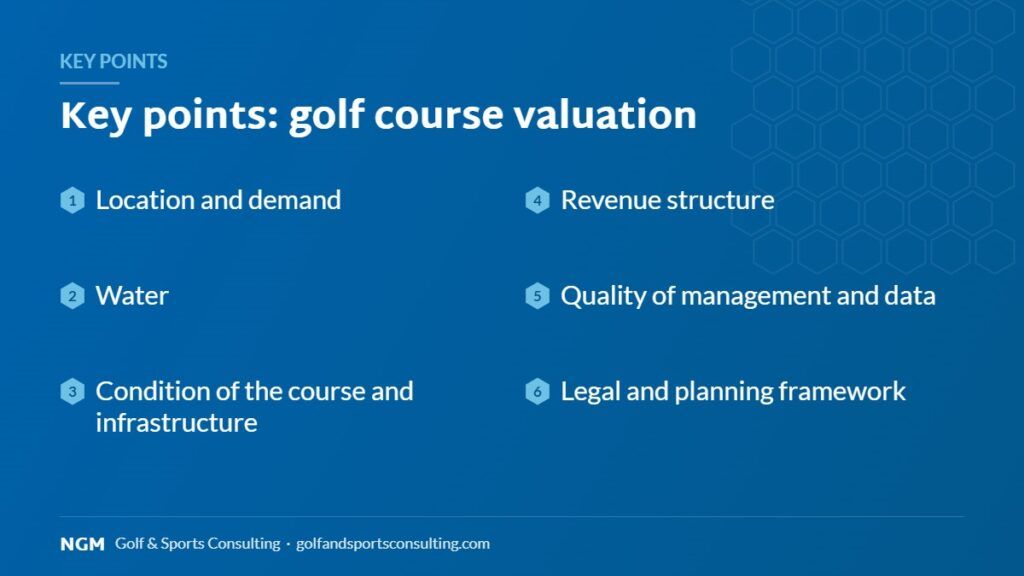
- Location and demand: resident population, tourist flows, accessibility and nearby competition.
- Water: source, long-term guarantee, cost and restrictions. In areas of scarcity, it is a critical factor.
- Condition of the course and infrastructure: irrigation, drainage, greens, machinery, clubhouse. Pending investment reduces value.
- Revenue structure: weight of members versus visitors, dependence on a single channel or tour operator, seasonality.
- Quality of management and data: a course with reliable booking, occupancy and spending information conveys less risk.
- Legal and planning framework: licences, concessions, charges and scope for new uses.
- Reputation and brand: positioning, reviews, tournaments and digital presence.

The weight of operational data in golf course valuation
Imagine two courses similar in location and design. The first takes bookings by phone, collects payments manually and does not know what percentage of its tee sheet is filled each month. The second has an integrated system with booking history, revenue by business line and customer data. The second is not necessarily more profitable, but it is much easier to value and therefore to finance and sell.
In practice, the more uncertainty there is about the figures, the more cautious the buyer will be and the bigger the discount they will apply. That is why an owner who plans to sell in a few years should start organising their data today. A good starting point is a KPI dashboard showing occupancy, average revenue per round and trends by business line. Management software such as Total Management makes exactly that traceability easier.
Common mistakes in golf course valuation
- Capitalising gross revenue instead of operating profit. A course can have high turnover and generate little cash.
- Forgetting recurring maintenance investment. Replacing machinery or renewing irrigation are certain costs, even if they are not annual.
- Taking development potential for granted. Without official confirmation, it should be treated as an option, not as value.
- Using comparables from other markets without adjusting them. A course in a mature tourist destination is not comparable with one in an inland residential area.
- Ignoring commitments to members. Playing rights, shares or frozen fees can limit future revenue.
How to prepare a course for a good valuation
If you are an owner and want a golf course valuation to reflect the asset’s potential, work on three fronts well in advance:
- Documentation in order: licences, water concessions, contracts and audited accounts, all accessible and up to date.
- Reliable operational data: bookings, occupancy, revenue by line and customer base in a single system.
- A costed investment plan: it is better to show what is missing and how much it costs than to let the buyer discover it and penalise it.
Improving profitability before a sale usually has more impact than any sales pitch; our article on golf course profitability covers the main levers, and our guide to golf and real estate investment explains how different uses fit into a single project.
Who should take part in the valuation
A solid golf course valuation is a team effort. It is worth combining the view of a qualified valuer, a technical specialist for the course and a management consultant who understands how the club operates. In Spain, the Bank of Spain supervises appraisal companies, which is relevant when a golf course valuation is used to obtain mortgage financing; other countries have their own regulated valuers. For legal and tax matters, especially in international deals, local advice is essential.
Frequently asked questions about golf course valuation
Which method is best for a golf course valuation? It depends on the situation. For an operating course, the income method is usually the main one, cross-checked with comparables and replacement cost. For land with potential, the residual method is added.
How often should the valuation be updated? Whenever there is a significant change: a sale, a refinancing, an expansion or a major shift in the business. Having an up-to-date reference also helps internal decision-making.
Does digitalisation affect the price? It does not create value by itself, but it reduces uncertainty about the figures and demonstrates management capability, two things any buyer or lender takes into account.
At NGM Golf & Sports Consulting we help owners and investors understand what a course is really worth and which levers can increase that value. If you are preparing a purchase, a sale or a refinancing, let’s talk through our golf course investment service.