

Staff training is one of the most underused levers in golf club management. Clubs invest in machinery, software and the clubhouse, yet the team that looks after members usually learns “on the fly”, copying whichever colleague has been there longest.
The outcome is familiar: everyone works their own way, mistakes keep repeating and good professionals leave because they see no future.
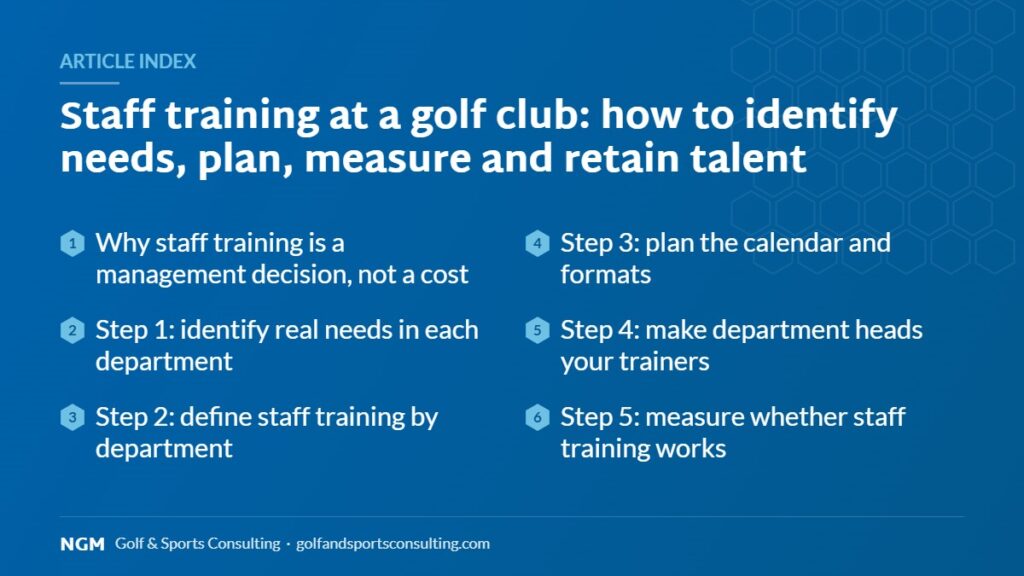
In this article we propose a six-step method to organise staff training by department (reception, caddie master, food and beverage, greenkeeping and academy), measure whether it works and use it as a tool to retain your team.
Why staff training is a management decision, not a cost
A club is a service business. Members value the condition of the course, but what they remember most is how they were treated at reception, whether their tee time went off on schedule and whether the restaurant knew their preferences. All of that is produced by the team, not by the facilities.
Treating staff training as discretionary spending (the first thing cut when the budget gets tight) is a common mistake. Done well, it reduces incidents, shortens the learning curve for seasonal hires and allows more delegation, freeing management for higher-value work.
It also affects retention: feeling that the club is investing in you is a strong reason to stay.
Step 1: identify real needs in each department
Before buying courses, you need to know what is missing. Needs are identified by combining three sources:
- Service data: complaints, tee sheet incidents, billing errors, waiting times in the restaurant and the results of customer satisfaction surveys.
- Direct observation: the general manager or department heads spend a shift in each role and note where the work gets stuck.
- Conversations with the team: short interviews in which each person explains what they find difficult, what they would like to learn and what they would do better if they knew how.
With that information, build a simple matrix: roles in the rows, required skills in the columns and, in each cell, the current level versus the target level. The biggest gaps in the roles with the most member contact set the priorities.
Step 2: define staff training by department
Each area of the club has different needs. A generic plan (“customer service for everyone”) helps little if it does not reach the day-to-day reality of each role.
Reception and caddie master
They are the face of the club. Here, staff training should cover the booking and payment system, waiting lists and tee time changes, the member and guest policy, handling complaints at the desk and a basic knowledge of the Rules of Golf and the club’s own regulations.
Food and beverage
In the restaurant and on the terrace, the priorities are table service, suggestive selling, knowledge of the menu and allergens, food hygiene and coordination with tournaments. If this area matters for the profit and loss account, link the plan to your strategy for golf club restaurant revenue.
Greenkeeping
The course team needs technical training (agronomy, irrigation, machinery, plant protection products), occupational health and safety and, increasingly, sustainability criteria and efficient water use. Professional associations such as the Spanish Greenkeepers Association are a good reference for finding technical sessions and content.
Academy
Academy professionals usually have strong technical training as golfers, but not always as salespeople or group managers. It is worth reinforcing communication with beginners, programme sales and progress tracking, in line with the golf school model the club wants to build.
Step 3: plan the calendar and formats
Golf has very marked seasons, and staff training must respect them. Training in peak season, with a full tee sheet, usually ends in cancelled sessions or in people attending while thinking about everything they still have to do.
Some practical guidelines:
- Concentrate intensive training in the quieter months and before seasonal staff join.
- Combine formats: short classroom sessions, on-the-job training with a reference colleague and video content that can be viewed on a phone.
- Prepare an onboarding plan for every new hire, with a role manual, an assigned mentor and a list of tasks to master in the first few weeks.
- Document key processes in simple checklists as the backbone of staff training: if only one person knows how to do something, the club is exposed.
In Spain, companies can fund part of their training through the subsidised training credit (formación bonificada, managed via the public foundation FUNDAE). Requirements and deadlines should be checked with your employment adviser or official sources before planning; other countries have their own schemes.
Step 4: make department heads your trainers
The most effective staff training does not always come from outside. Department heads know the club, the member profile and the usual mistakes. Giving them time and a script to train their own teams is inexpensive and highly effective.
For this to work, middle managers first need to learn how to teach: explain the reason behind each task, demonstrate, let people practise and correct them respectfully.

Step 5: measure whether staff training works
What is not measured eventually disappears from the budget. To evaluate staff training, counting hours or courses is not enough: you need to see whether anything has changed in the service.
Useful indicators by department:
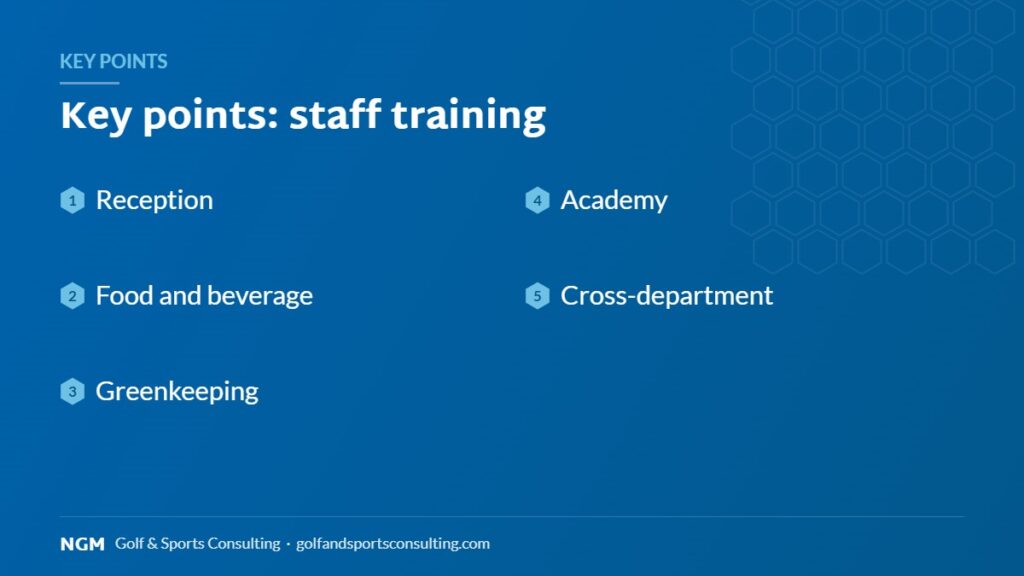
- Reception: booking and billing incidents, average handling time, recorded complaints.
- Food and beverage: average ticket, table turnover on tournament days, service ratings.
- Greenkeeping: compliance with the work plan, machinery incidents, workplace accidents.
- Academy: students who repeat a programme and conversion from single lessons to courses.
- Cross-department: member satisfaction, staff turnover and time until a new hire works independently.
These figures fit naturally into a golf club KPI dashboard. Reviewing them every quarter alongside the training plan lets you reinforce what works and stop paying for what adds nothing.
Step 6: turn training into a team loyalty tool
A well-communicated staff training plan is also a message: “you can grow here”. For the team to see it that way:
- Link training to visible career paths (from assistant to supervisor, from reception to events coordination).
- Recognise progress: internal certificates, mentions in meetings, small incentives for reaching new levels.
- Ask for feedback after each training session and act on it.
- Include returning seasonal workers: training them well means they come back the following season with the learning curve already behind them.
Imagine a club that every winter dedicates staff training for reception and food and beverage to preparing for the high season, and keeps the same people for several years. Members notice: staff know them by name and solve their requests without passing them between three people.
Frequently asked questions about staff training
How much time should a golf club dedicate to staff training? It depends on the size of the club and staff turnover, but what matters is continuity: an intensive block before the season and short, regular sessions for the rest of the year work better than an isolated course.
Who should lead staff training? Management sets priorities and budget, but day-to-day delivery works best in the hands of each department head, with external support for technical or specialised content.
How can the investment be justified to the board? With before-and-after indicators: fewer incidents, higher member satisfaction, lower turnover and less time for new hires to become productive. Presented this way, training becomes a management decision rather than a cost.
If you want to organise your team’s development within an overall management plan, with priorities by department and clear indicators, NGM can help you design it and put it into practice. Find out how we work in our golf course management service.